
Key Takeaways
80-90% of all enterprise data is unstructured: emails, contracts, images, audio, video.
LLMs, computer vision, and multimodal AI now enable enterprise-scale unstructured data processing.
Knowledge graphs and semantic search (RAG) connect millions of documents into queryable intelligence.
High-impact use cases span healthcare, finance, manufacturing, and legal.
Organizations that master unstructured data gain intelligence their competitors cannot see.
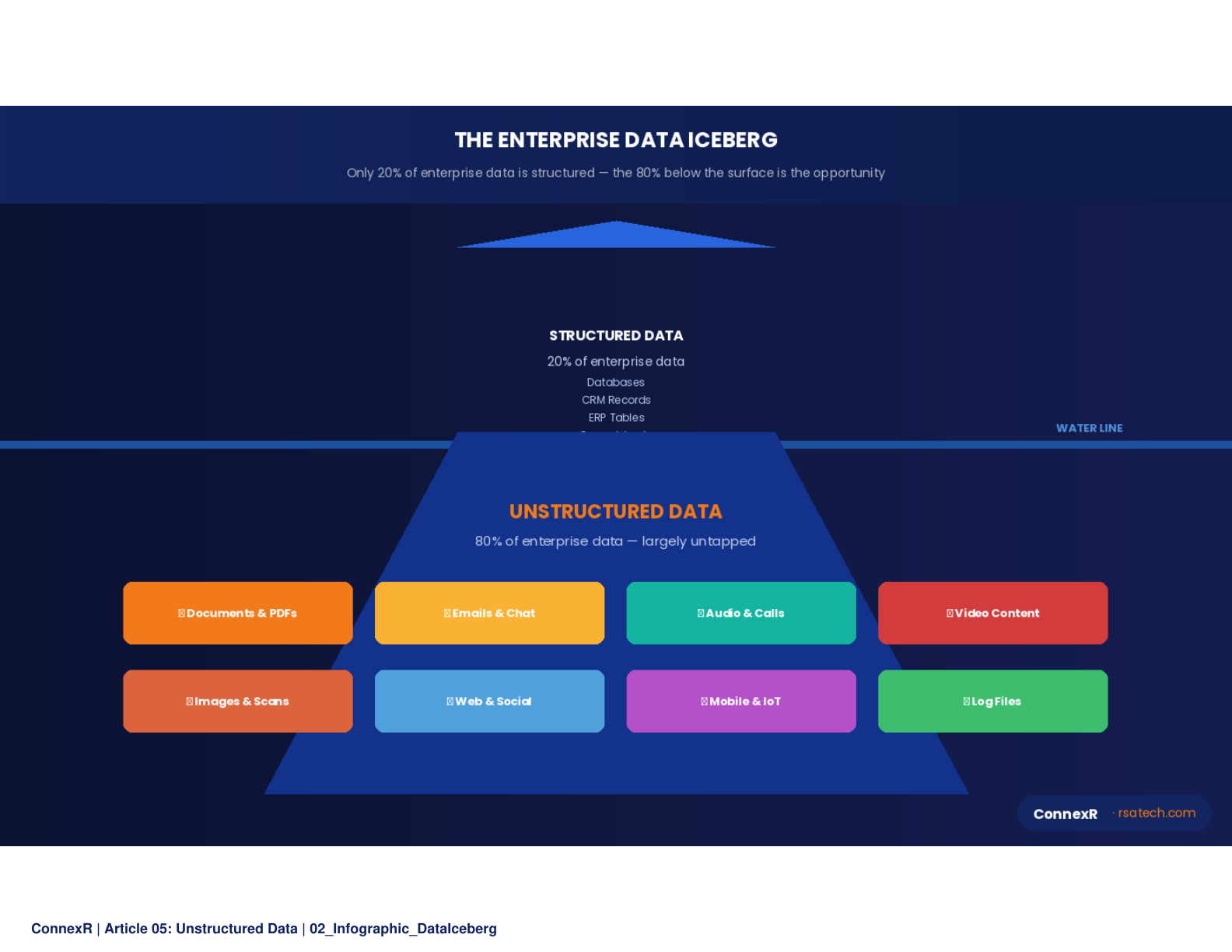
Every enterprise sits on a goldmine it cannot access. Industry analysts estimate that 80 to 90% of all enterprise data is unstructured: emails, contracts, customer support transcripts, medical images, engineering documents, meeting recordings, social media interactions, and sensor logs that exist outside the neat rows and columns of traditional databases.
This data contains enormous potential value. Customer sentiment is embedded in support tickets. Competitive intelligence lives in sales call transcripts. Compliance risks hide in contract language. Operational insights are buried in maintenance logs. But for most organizations, unstructured data remains a dark asset, stored at significant cost but never systematically analyzed, because the tools and techniques to extract value from it at enterprise scale have not been available.
That is changing. Advances in large language models, computer vision, speech recognition, and multimodal AI have made it possible -- for the first time -- to process, understand, and derive insights from unstructured data at a scale and accuracy that were unthinkable five years ago. For data leaders, this represents both the most significant opportunity and the most complex challenge on their roadmap.
Why Unstructured Data Has Been the Enterprise Blind Spot
The challenge of unstructured data is not new. Organizations have been accumulating unstructured content since the first email was sent and the first document was filed. What has kept it largely inaccessible is a combination of volume, variety, and the limitations of traditional analytics tools.
Volume That Overwhelms Traditional Approaches
A mid-size enterprise generates millions of emails, thousands of documents, and hundreds of hours of meeting recordings every month. Processing this volume with manual review or rules-based extraction is not feasible. Even organizations with dedicated data teams can only sample a fraction of their unstructured data, leaving the vast majority unexamined.
Variety That Defies Standardization
Unstructured data comes in dozens of formats: PDFs, Word documents, PowerPoint presentations, images, audio files, video recordings, chat logs, social media posts, web pages, and proprietary file types. Each format requires different processing pipelines. A system that can extract insights from text documents cannot process medical images. A speech-to-text pipeline does not help with engineering diagrams.
Context That Requires Understanding, Not Just Processing
The most valuable information in unstructured data is often contextual. A contract clause that seems routine in isolation may represent a significant liability in the context of a specific regulatory environment. A customer's tone on a support call may signal churn risk that the words alone do not convey. Extracting this contextual intelligence requires AI systems that can understand meaning, not just recognize patterns.
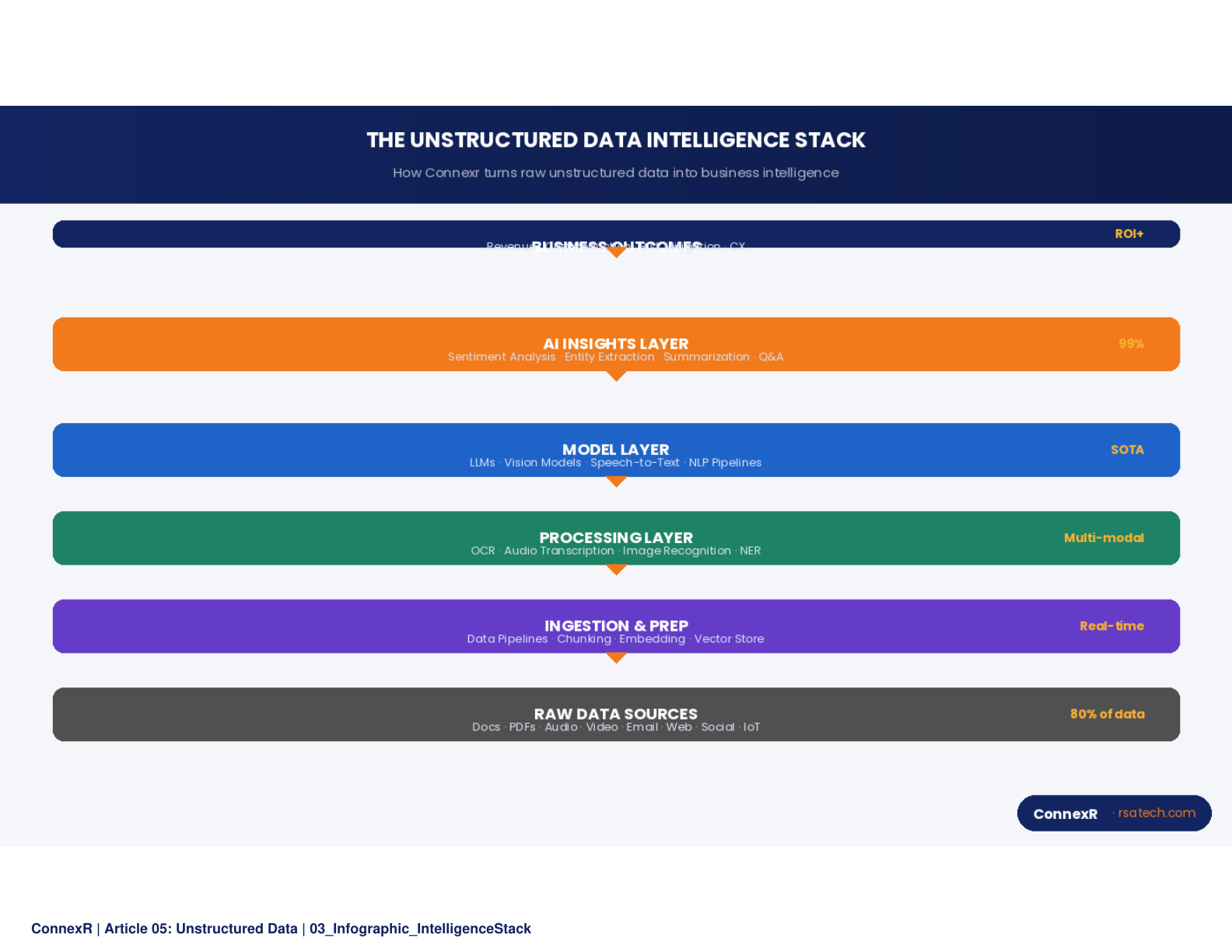
The Modern Unstructured Data Stack
Enterprises that are successfully extracting value from unstructured data are building integrated technology stacks that combine several layers of capability.
Intelligent Document Processing (IDP)
IDP platforms combine optical character recognition (OCR), natural language processing (NLP), and machine learning to extract structured data from documents at scale. Modern IDP systems can process invoices, contracts, claims forms, medical records, and regulatory filings, extracting not just text, but entities, relationships, and semantic meaning.
The most advanced IDP implementations use large language models to handle document variability. Rather than requiring rigid templates for each document type, LLM-powered IDP can adapt to new formats, understand context, and resolve ambiguities, dramatically reducing the configuration effort required for each new document type.
Multimodal AI for Rich Media
Text is only one dimension of unstructured data. Images, audio, and video contain equally valuable -- and often complementary -- information. Multimodal AI systems can:
- Analyze medical images to identify pathologies that complement clinical notes
- Process meeting recordings to extract action items, sentiment, and key decisions from both speech and shared visual content
- Evaluate manufacturing images alongside maintenance logs to predict equipment failures
The convergence of vision, language, and audio models into unified multimodal systems is one of the most significant technical developments for unstructured data analytics. It enables organizations to analyze content across modalities, identifying insights that would be invisible to single-modality systems.
Knowledge Graphs and Semantic Search
Extracting information from individual documents is useful. Connecting that information across millions of documents is transformative. Knowledge graphs provide the data structure that links entities, relationships, and events extracted from unstructured data into a navigable, queryable network of organizational knowledge.
A knowledge graph built from contract data, for example, can reveal the full network of obligations, counterparty relationships, and risk exposures across an enterprise's entire contract portfolio. One built from customer support interactions can map product issues to engineering defects to customer segments to revenue impact.
Semantic search, powered by vector embeddings and retrieval-augmented generation (RAG), complements knowledge graphs by enabling natural-language queries over unstructured content. Instead of keyword matching, semantic search understands intent and returns results based on meaning, making the organization's unstructured data accessible to anyone who can formulate a question.
"The organizations that master unstructured data analytics gain access to a dimension of intelligence their competitors cannot see."
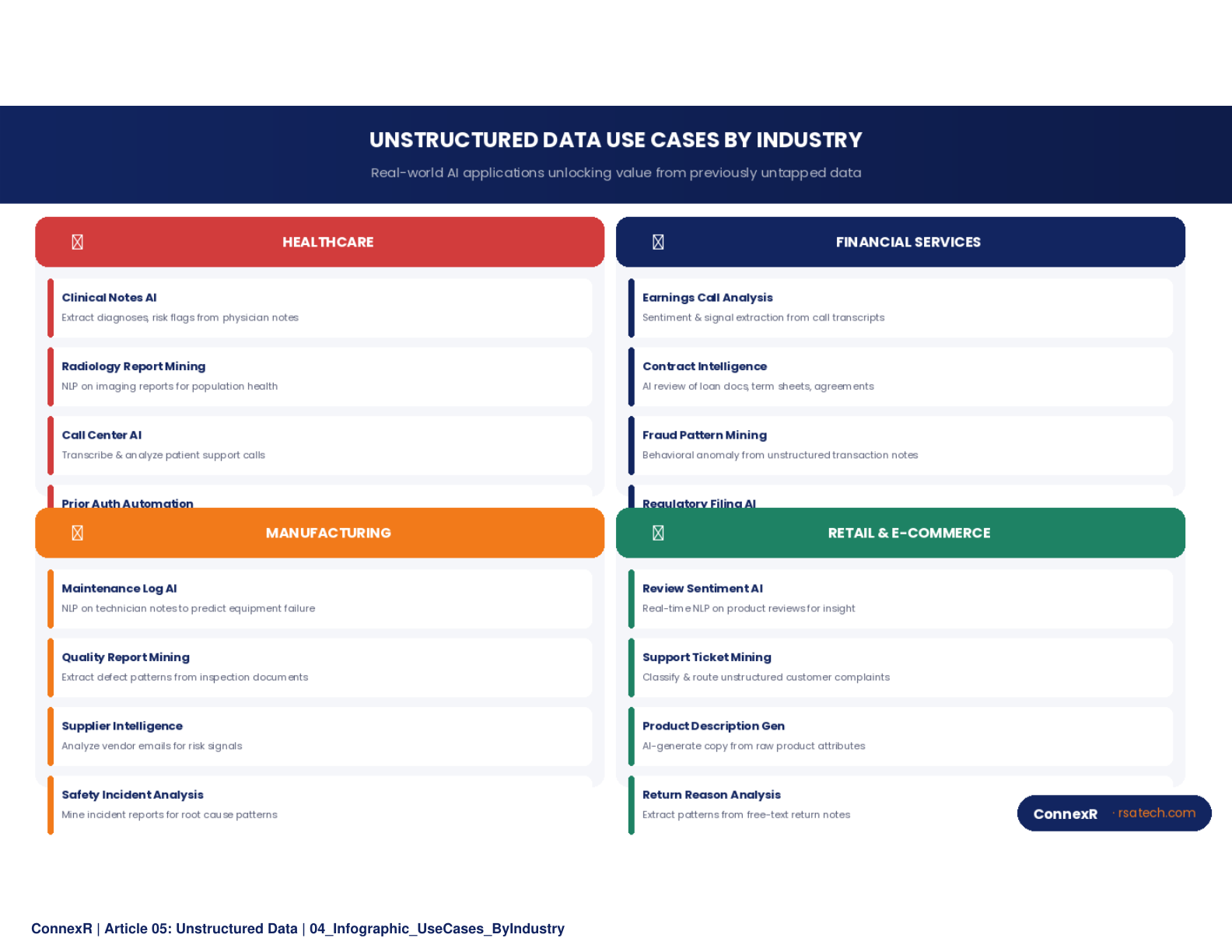
High-Value Use Cases Across Industries
Healthcare: Clinical Intelligence at Scale
Healthcare organizations generate enormous volumes of unstructured clinical data: physician notes, radiology reports, pathology images, patient correspondence, and insurance documentation. AI-powered unstructured data analytics can:
- Extract diagnoses, medications, and treatment outcomes from clinical notes to enable population health analytics
- Process radiology and pathology images to assist with diagnosis and screening
- Automate insurance prior authorization by extracting clinical evidence from patient records and matching it to payer requirements
For health systems, the ability to systematically analyze unstructured clinical data is transforming both operational efficiency and patient outcomes.
Financial Services: Risk and Compliance Intelligence
Financial institutions face a constant challenge of monitoring regulatory compliance, counterparty risk, and fraud across vast volumes of unstructured communications and documents. Modern unstructured data analytics enables:
- Automated review of contracts, disclosures, and regulatory filings for compliance risks
- Surveillance of communications (email, chat, voice) for insider trading indicators and conduct risk
- Extraction of risk signals from news, social media, and alternative data sources for credit and market risk assessment
Manufacturing: Operational Intelligence from the Shop Floor
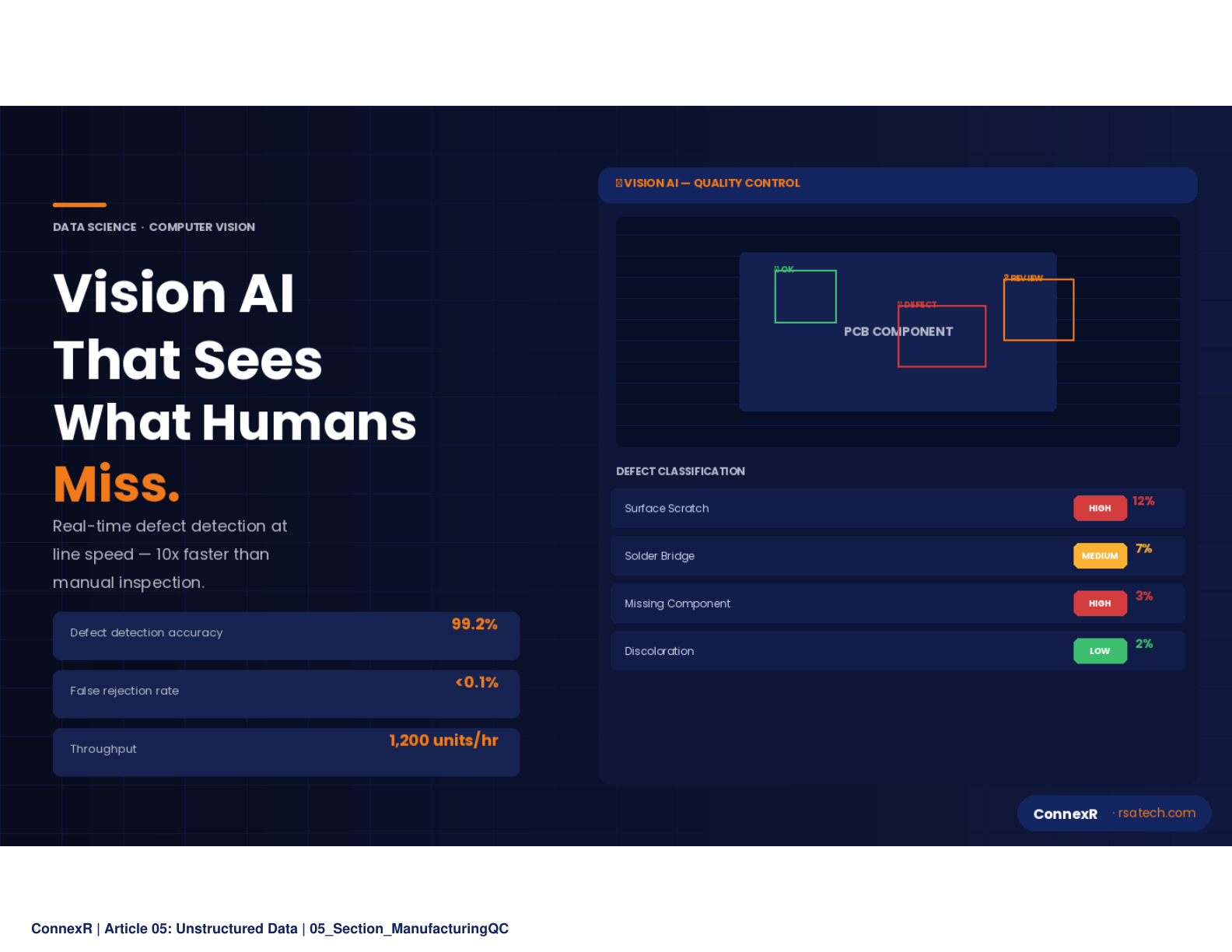
Manufacturing environments generate unstructured data from maintenance logs, quality inspection images, equipment sensor streams, and technician notes. Analyzing this data can predict equipment failures before they cause unplanned downtime, identify quality defects earlier in the production process, and optimize maintenance schedules based on actual equipment condition rather than fixed intervals.
Legal and Compliance: Contract Intelligence
Legal departments manage thousands of contracts, each containing obligations, deadlines, and risk provisions that must be tracked and enforced. Unstructured data analytics can:
- Extract and normalize key contract terms across the entire portfolio
- Identify clauses that conflict with current regulatory requirements
- Automate contract review workflows by surfacing high-risk provisions for human review
- Enable portfolio-wide risk analysis that would be impossible with manual review
Unstructured Data by the Numbers
80-90% -- Enterprise data that is unstructured
55-65% -- Annual growth rate of unstructured data
< 20% -- Enterprises with an unstructured data strategy
Up to 80% -- Time savings with AI-powered document processing
95%+ -- Accuracy of modern IDP on standard documents
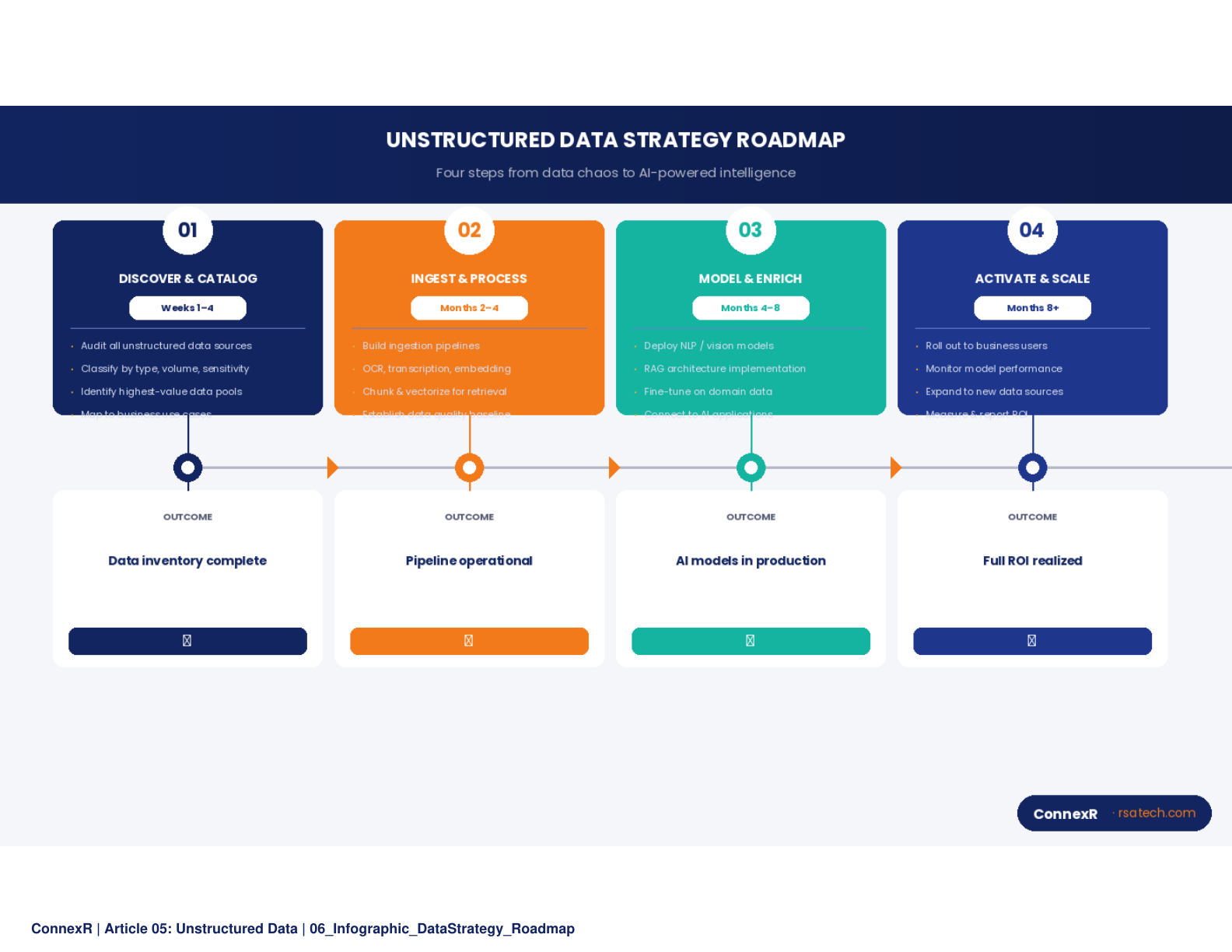
Building an Enterprise Unstructured Data Strategy
For data leaders looking to unlock the value of unstructured data, the path forward involves several strategic decisions.
Start with a Data Audit
Before investing in technology, understand what unstructured data exists across the organization, where it lives, how it is generated, and what business questions it could answer. This audit often reveals surprising concentrations of high-value unstructured data that the organization did not know it had.
Prioritize Use Cases by Business Impact
Not all unstructured data is equally valuable. Prioritize use cases where extracting insights from unstructured data directly impacts revenue, cost, risk, or compliance. Fraud detection in financial services, clinical documentation in healthcare, and contract analysis in legal are consistently high-impact starting points.
Invest in Data Governance for Unstructured Content
Unstructured data governance is less mature than structured data governance in most organizations, but it is equally important. Classification, retention, access control, and privacy policies must extend to unstructured content, particularly when AI systems are processing it at scale.
Build for Scale from Day One
Unstructured data volumes grow faster than structured data. The technology stack and operational processes must be designed for scale: not just for the initial use case, but for the hundreds of terabytes and millions of documents that will follow.
The Competitive Advantage of Unstructured Data Mastery
The organizations that master unstructured data analytics will have access to a dimension of intelligence that their competitors cannot see. They will understand their customers more deeply, manage their risks more precisely, operate more efficiently, and make better decisions, because they are analyzing 100% of their data, not just the 10 to 20% that fits neatly into a database.
The technology to unlock unstructured data is here. The strategic question is whether your organization will be among the first to deploy it, or among the last to catch up.
Ready to Unlock Your Enterprise's Hidden Intelligence? Connexr helps enterprises design and build intelligent data platforms that unlock value from both structured and unstructured data. Our AI-powered data orchestration and analytics capabilities transform dark data into actionable intelligence.