
Key Takeaways
Sitecore XM Cloud and Content Hub combine headless CMS, composable architecture, and AI-native personalization into a single platform.
E-commerce brands using AI-powered personalization see up to 30% increases in conversion rates and 25% improvements in average order value.
AI Data Agents represent a paradigm shift in BI: autonomous agents that query, analyze, and act on data without human analysts writing SQL or building dashboards.
The convergence of Sitecore with AI Data Agents creates a closed-loop intelligence system where customer behavior informs real-time content and merchandising.
Organizations that treat digital transformation as a platform strategy (not a project) achieve 2 to 3x faster time-to-market on new digital experiences.
The enterprise digital experience landscape is undergoing its most significant transformation in a decade. For years, organizations built their digital presence on monolithic CMS platforms that tightly coupled content management, delivery, and personalization into rigid, hard-to-evolve architectures. That model is breaking down under the weight of omnichannel demands, rising customer expectations, and the explosive growth of AI-driven commerce.
At the center of this shift is a new architectural paradigm: composable digital experience platforms (DXPs) that combine headless content management, AI-native personalization, and autonomous data intelligence into systems that adapt in real time to customer behavior. Sitecore, one of the most widely deployed enterprise DXPs, has been at the forefront of this evolution with its shift to cloud-native, composable architecture. And the emergence of AI Data Agents is adding an entirely new layer of intelligence that transforms how enterprises understand, reach, and convert their customers.
The Sitecore Evolution: From Monolith to Composable DXP
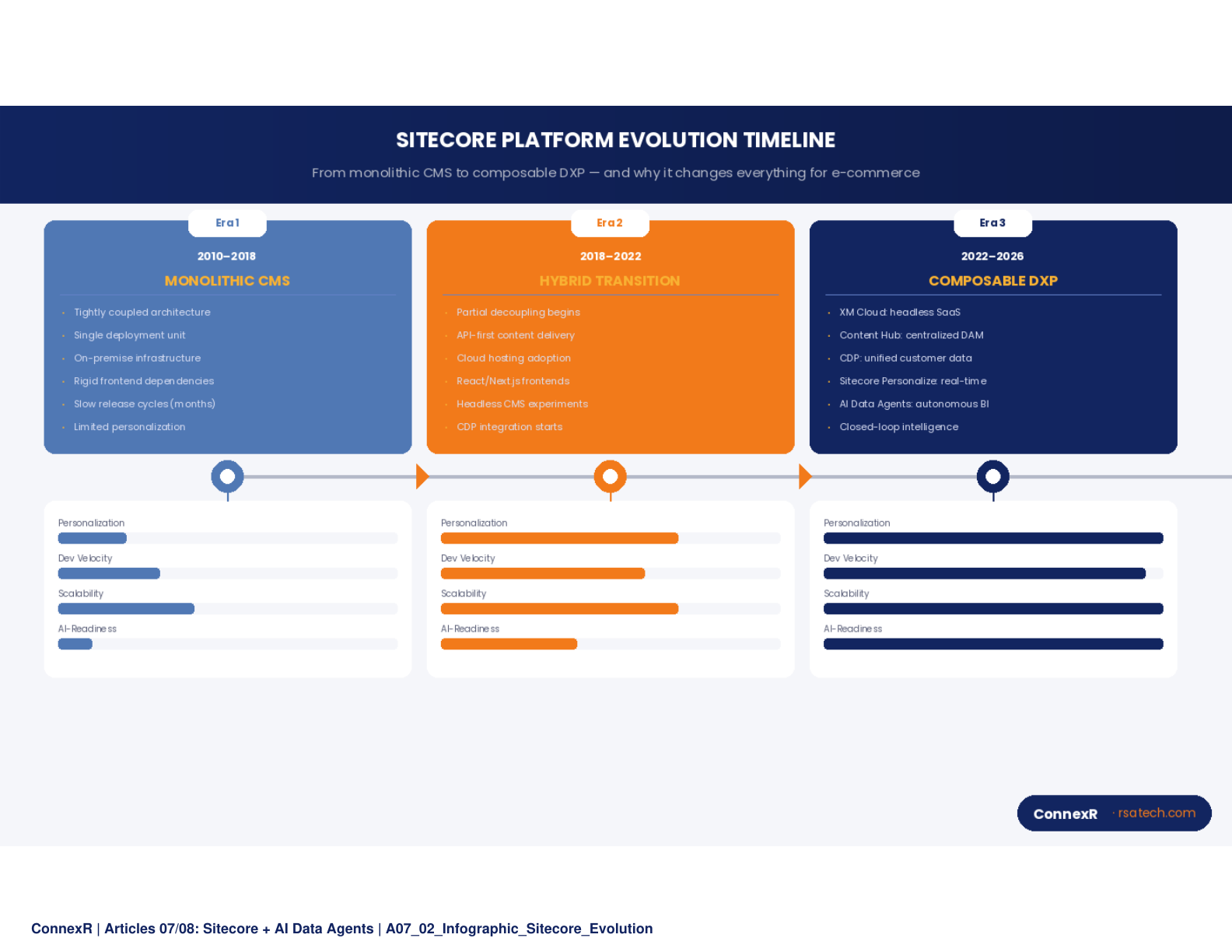
Sitecore XM Cloud: Headless, Composable, and Cloud-Native
Sitecore XM Cloud represents a fundamental departure from the traditional Sitecore deployment model. Instead of a monolithic application running on dedicated infrastructure, XM Cloud delivers content management as a cloud-native SaaS service with fully headless APIs.
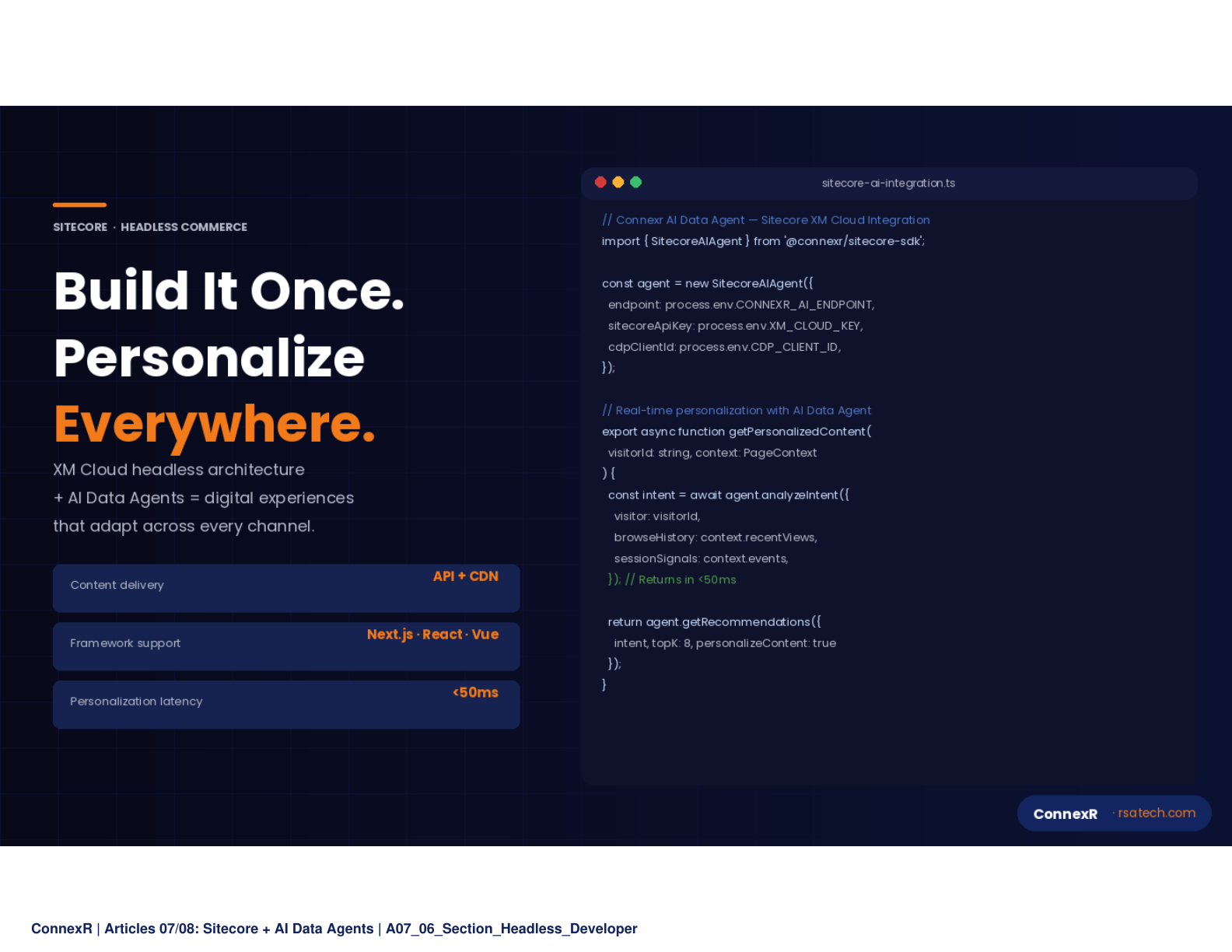
This means frontend development teams can build digital experiences using any framework (Next.js, React, Angular, Vue) while content authors work in a familiar WYSIWYG editing environment. Content is delivered via APIs and CDN, enabling global performance, instant scalability, and true omnichannel delivery from a single content source.
For e-commerce organizations, this architecture unlocks several critical capabilities:
- Decoupled storefronts that can evolve independently of the content management layer
- Omnichannel content delivery across web, mobile app, in-store kiosk, IoT devices, and emerging channels
- Faster time-to-market for new campaigns, landing pages, and product experiences without backend deployment cycles
- Global scalability with CDN-first delivery and auto-scaling infrastructure
Content Hub and DAM: Centralized Asset Intelligence
Sitecore Content Hub provides a centralized digital asset management (DAM) and content operations platform that connects to every channel in the digital ecosystem. For e-commerce brands managing thousands of product images, videos, and marketing assets across dozens of channels and regions, Content Hub eliminates the asset chaos that plagues distributed teams.
AI-powered features within Content Hub (auto-tagging, image recognition, content recommendation) reduce the manual effort of organizing and distributing assets, while workflow automation ensures brand consistency across every touchpoint.
Sitecore Personalize and CDP: Real-Time Customer Intelligence
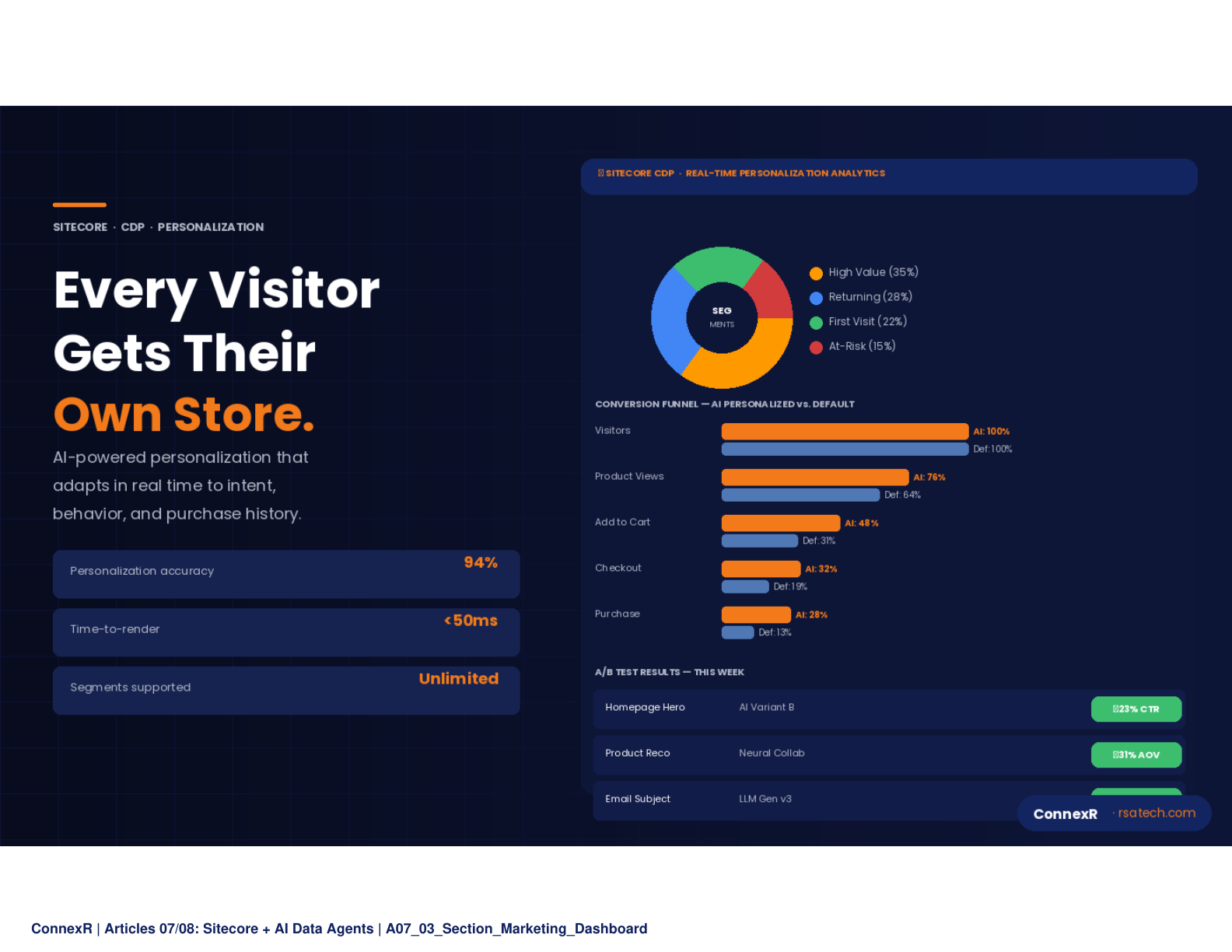
Sitecore Personalize, combined with the Sitecore Customer Data Platform (CDP), delivers real-time personalization powered by unified customer profiles. The CDP aggregates behavioral data, transaction history, and interaction signals from every channel into a single customer view. Sitecore Personalize then uses this data to deliver individualized content, offers, and experiences in real time.
For e-commerce, this means:
- Product recommendations that adapt based on browsing behavior, purchase history, and real-time intent signals
- Dynamic pricing and promotion delivery targeted to customer segments with precision
- Personalized search results that surface the most relevant products for each visitor
- Abandoned cart recovery with personalized messaging and incentive optimization
"Digital transformation is not about replacing one platform with another. It is about building the architectural foundation that lets your digital experience evolve continuously."
AI Data Agents: The New Intelligence Layer for Digital Commerce
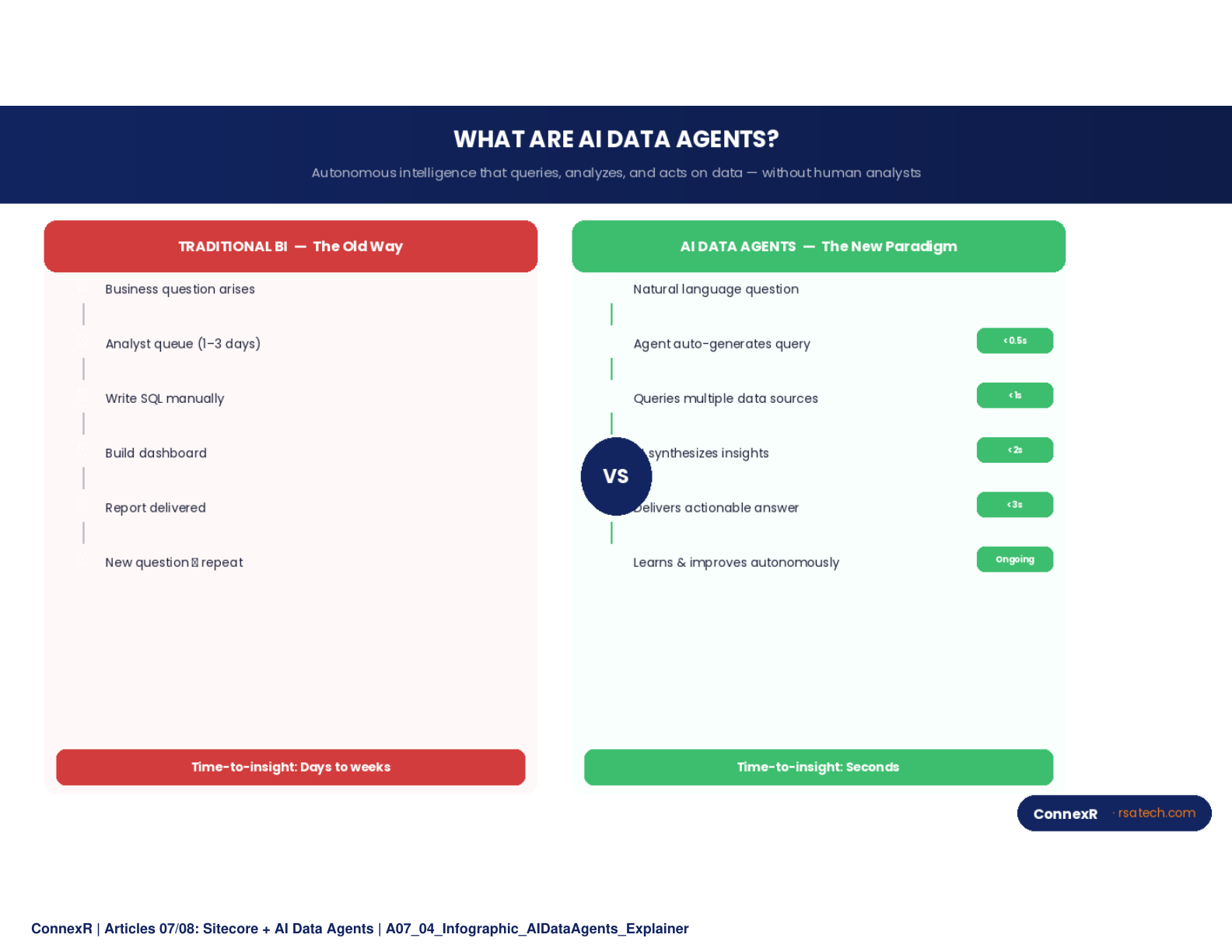
What Are AI Data Agents?
AI Data Agents are autonomous AI systems that can understand natural language questions about business data, formulate the appropriate queries, execute them against data warehouses and BI platforms, analyze the results, and present actionable insights. Unlike traditional BI tools that require analysts to write SQL, build reports, and interpret dashboards, AI Data Agents make data intelligence accessible to anyone in the organization.
A marketing director can ask, "What was our conversion rate by channel for the last quarter, and how does it compare to the same period last year?" The AI Data Agent interprets the question, queries the underlying data (Snowflake, Databricks, BigQuery, or whatever warehouse the organization uses), performs the analysis, and returns the answer in natural language with supporting visualizations.
But AI Data Agents go beyond question answering. They can:
- Monitor KPIs autonomously and alert stakeholders when metrics deviate from expected ranges
- Generate scheduled reports with narrative summaries that explain what the data means, not just what it shows
- Identify patterns and anomalies that human analysts might miss across large, complex datasets
- Chain multiple analyses together to answer compound business questions spanning multiple data sources
- Recommend actions based on data patterns, such as suggesting inventory adjustments based on demand signals
AI Data Agents in the E-Commerce Stack
For e-commerce organizations, AI Data Agents transform several critical business functions:
- Merchandising Intelligence. AI Data Agents continuously analyze product performance, inventory levels, and demand signals to recommend which products to feature, where to allocate inventory, when to adjust pricing, and how to optimize category pages.
- Customer Analytics. Instead of waiting for the analytics team to build a cohort analysis, a product manager can ask the AI Data Agent to segment customers by behavior, identify at-risk accounts, and recommend retention strategies.
- Marketing Attribution. AI Data Agents navigate complex multi-touch attribution models, answering questions like "Which combination of channels drove the highest lifetime value customers last quarter?"
- Operational Analytics. From fulfillment performance to return rate analysis to supplier lead time tracking, AI Data Agents make operational data accessible to the teams that need it.
Key Metrics: AI-Powered Digital Commerce
- Conversion rate increase with AI personalization: Up to 30%
- Average order value improvement: 25%
- Time savings on analytics with AI Data Agents: 60-80%
- Enterprises adopting composable DXP by 2027 (Gartner): 60%
- Reduction in time-to-market with headless architecture: 2-3x
The Convergence: Sitecore + AI Data Agents = Closed-Loop Intelligence
The most powerful digital commerce architectures create a closed-loop intelligence system where customer behavior data flows from the experience layer into the analytics layer, AI Data Agents analyze that data and generate insights, and those insights flow back into the experience layer to optimize content, personalization, and merchandising in real time.
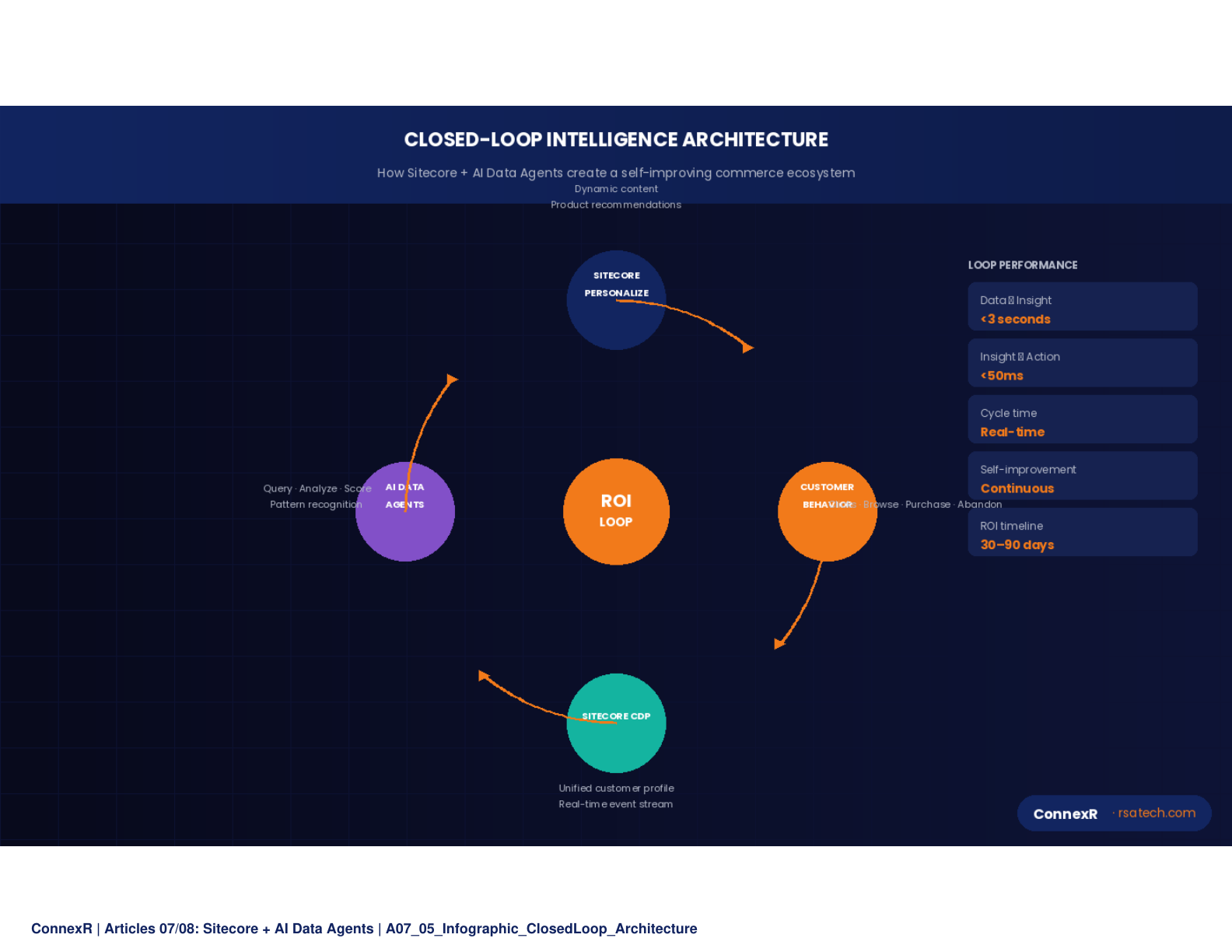
How This Works in Practice
Consider a mid-market retailer running Sitecore XM Cloud for their digital storefront with Sitecore Personalize for real-time personalization and an AI Data Agent connected to their Snowflake data warehouse.
- Step 1: Data Collection. Sitecore CDP captures every customer interaction: page views, product clicks, search queries, cart additions, purchases, and abandonment events. This data flows into Snowflake alongside transaction data from POS, inventory data from ERP, and marketing campaign data.
- Step 2: AI Data Agent Analysis. The agent detects that a specific product category is experiencing a 15% increase in browse-to-cart conversion but a 25% drop in cart-to-purchase completion. It surfaces this insight with a recommendation to test a free shipping threshold.
- Step 3: Action in Sitecore. The merchandising team creates a personalization variant in Sitecore Personalize showing a "Free shipping on orders over $75" banner. The A/B test runs automatically.
- Step 4: Feedback Loop. The AI Data Agent monitors test results and reports: "The free shipping variant increased cart-to-purchase conversion by 18% with no measurable impact on average order value. Recommend rolling out to all visitors."
This cycle (data collection, analysis, action, measurement) runs continuously, creating a digital commerce engine that gets smarter with every customer interaction.
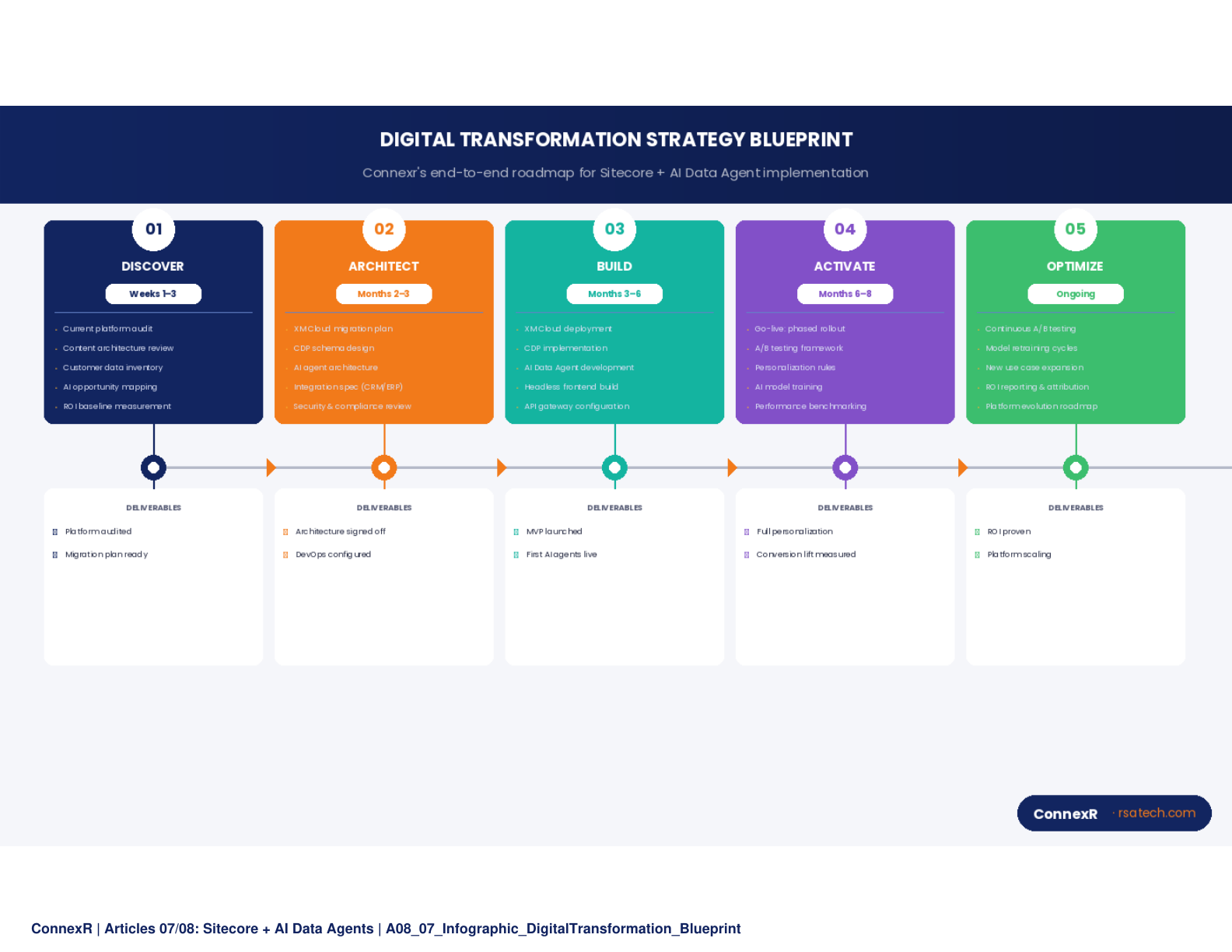
Building a Modern Digital Transformation Strategy
Adopt Composable Architecture from Day One
The era of monolithic digital platforms is over. A composable architecture (where CMS, commerce engine, personalization, search, and analytics are independent, best-of-breed services connected via APIs) provides the flexibility to evolve each component independently without system-wide disruption.
Invest in a Unified Data Foundation
AI Data Agents and AI-driven personalization are only as good as the data they can access. A modern data warehouse (Snowflake, Databricks, BigQuery) that consolidates customer, product, transaction, and marketing data into a unified, queryable source is a prerequisite for intelligent digital commerce.
Treat Personalization as Infrastructure, Not a Feature
Personalization should not be a bolt-on feature applied to individual pages. It should be an architectural layer that influences every customer touchpoint: search results, product recommendations, email content, pricing, and even navigation.
Democratize Data with AI Agents
The bottleneck in most organizations is not data collection but data access. Marketing teams, merchandising teams, and business leaders often wait days or weeks for the analytics team to answer their questions. AI Data Agents eliminate this bottleneck by making data intelligence available to everyone through natural language interfaces.
Why Connexr for Sitecore and AI-Powered Digital Transformation
- Deep Sitecore expertise across XM Cloud, Content Hub, Personalize, CDP, and Search, with experience migrating monolithic Sitecore XP deployments to modern composable architecture
- Enterprise data platform engineering with Snowflake, Databricks, Tableau, Power BI, and BigQuery to build the unified data foundation that AI agents require
- AI Data Agent development powered by our LeoRix AI platform, enabling natural language data querying, autonomous analysis, and intelligent alerting
- End-to-end managed services with 24/7 operations, SOC 2 and HIPAA compliance, and outcome-based engagement models that align incentives with results