
Key Takeaways
80% of financial data will be generated outside traditional data centers by 2027, driving the shift toward edge-based predictive analytics in financial services.
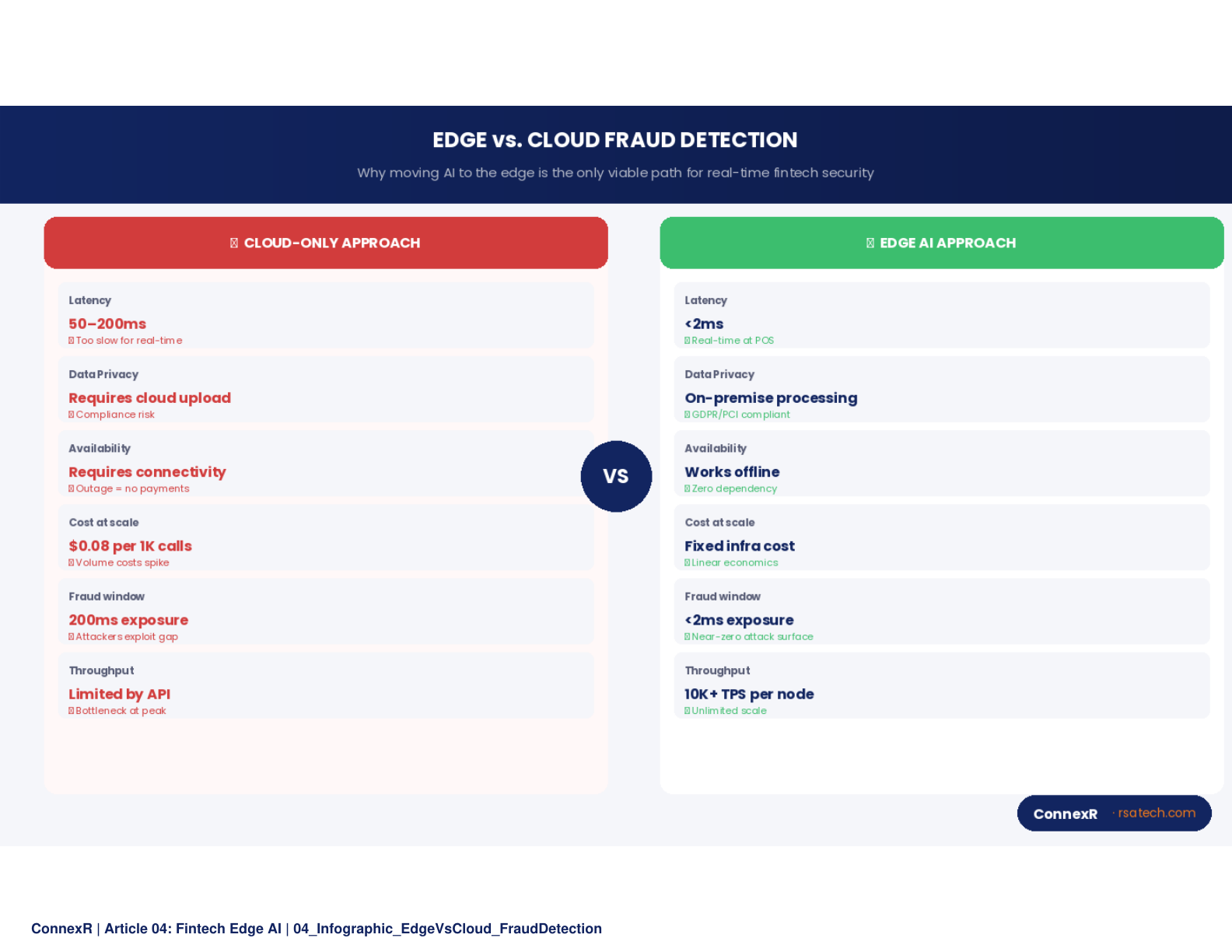
Edge-based fraud detection evaluates transactions in under 10 milliseconds, compared to 200-500 milliseconds for cloud-based systems, dramatically reducing false positives.
Federated learning enables model improvement without centralizing sensitive financial data, addressing both privacy and regulatory concerns across distributed networks.
New use cases are emerging: real-time personalized banking, instant credit decisioning, and sub-millisecond trading powered by edge AI.
Financial institutions deploying edge AI now will define the next decade of fintech, gaining competitive advantage in fraud prevention, customer experience, and operational efficiency.
Financial services have always been a data-intensive industry. But the volume, velocity, and variety of data flowing through modern fintech systems have reached a scale where traditional centralized analytics architectures are hitting fundamental limitations. When a fraud detection system needs to evaluate a transaction in under 50 milliseconds, or an algorithmic trading platform requires sub-millisecond inference, sending data to a distant cloud data center for processing is not fast enough.
This is driving a fundamental shift in how financial institutions deploy predictive analytics: moving intelligence from centralized cloud environments to the edge, where decisions are made closest to the data source and the end user. Edge-based predictive analytics represents the next frontier for fintech, combining the power of machine learning with the speed of local computation to deliver real-time financial intelligence at unprecedented scale.
Why Edge Computing Matters for Financial Services
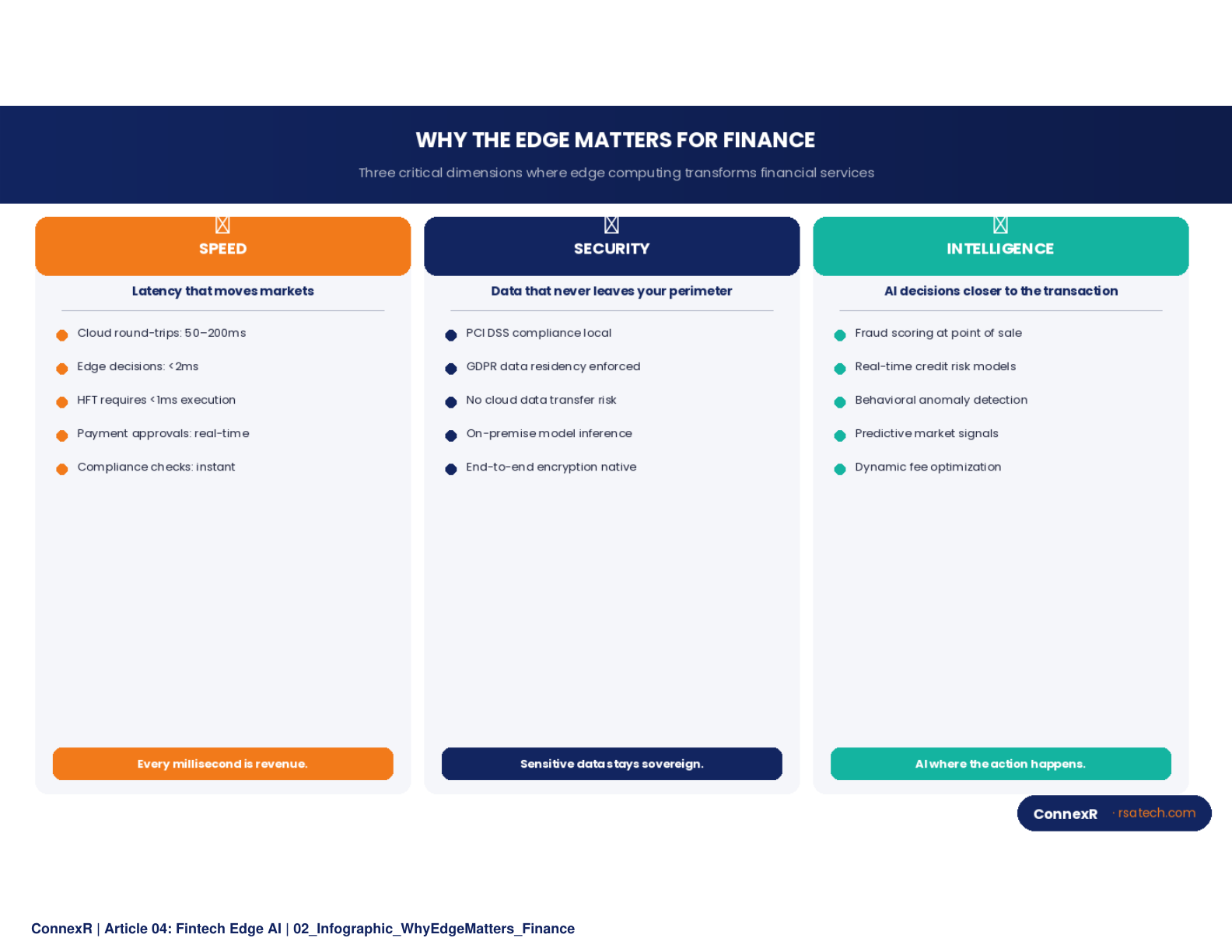
Edge computing brings computation and data storage closer to the point of need, whether that is a bank branch, a payment terminal, a mobile device, or a trading floor. For financial services, the benefits are particularly compelling.
Latency Reduction
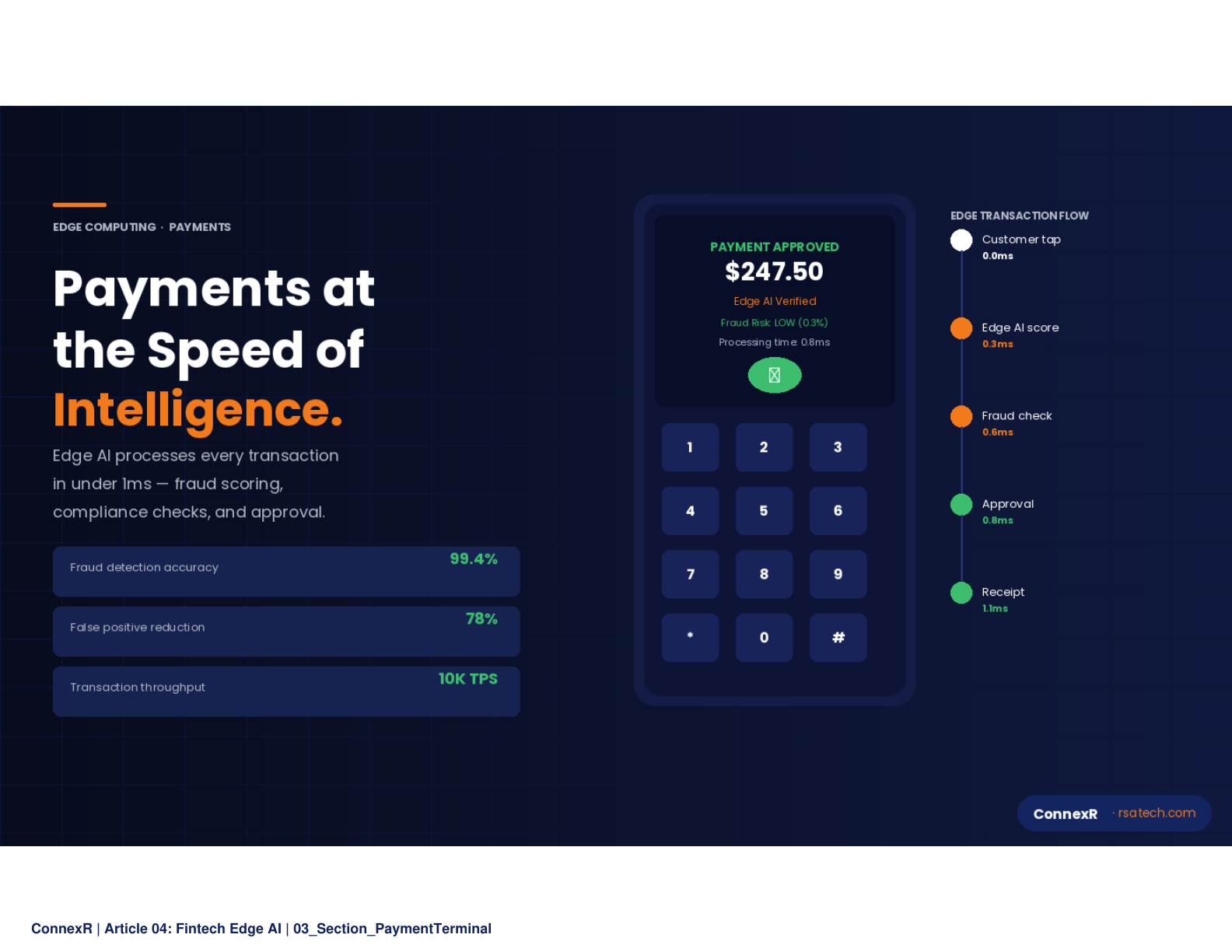
In financial services, milliseconds translate directly to money. High-frequency trading systems measure competitive advantage in microseconds. Fraud detection systems have a narrow window to approve or decline a transaction before the customer experience degrades. Credit decisioning at the point of sale must be instantaneous.
Edge computing eliminates the round-trip latency to centralized cloud infrastructure. By running predictive models locally -- on edge servers, specialized hardware, or even embedded in payment terminals -- financial institutions can reduce inference latency from hundreds of milliseconds to single digits.
Data Sovereignty and Compliance
Financial data is among the most heavily regulated in the world. GDPR, PCI DSS, SOX, and a growing patchwork of national data localization laws impose strict requirements on where financial data can be processed and stored. Edge computing allows organizations to process sensitive data locally -- within a specific geographic jurisdiction, within a bank's own network, or even within a single branch -- without exposing it to the broader network.
This is particularly relevant for cross-border financial institutions that must comply with multiple regulatory regimes simultaneously. Edge processing can ensure that a customer's transaction data is analyzed within the jurisdiction where it was generated, with only aggregated, anonymized insights transmitted to centralized systems.
Resilience and Availability
Edge computing reduces dependence on network connectivity to centralized infrastructure. A payment terminal with local fraud detection capability can continue to evaluate transactions even during a network outage. A branch banking system with edge-based credit scoring can serve customers when the connection to headquarters is interrupted.
Edge for Emerging Markets
For financial institutions operating in regions with unreliable connectivity -- rural banking, emerging markets, maritime finance -- edge computing is not just a performance optimization. It is an availability requirement, ensuring continuous service delivery regardless of network conditions.
Key Use Cases: Predictive Analytics at the Financial Edge
Real-Time Fraud Detection and Prevention
Fraud detection is the most mature and highest-impact application of edge-based predictive analytics in financial services. Traditional fraud detection relies on centralized rule engines and batch-processed models. Modern edge-based systems deploy machine learning models directly on payment processing infrastructure, evaluating each transaction against behavioral patterns, device fingerprints, geolocation data, and network signals in real time.
The result is a dramatic improvement in both detection accuracy and response time. Edge-based fraud systems can evaluate thousands of features per transaction in under 10 milliseconds, compared to 200 to 500 milliseconds for cloud-based systems. This speed advantage is critical for reducing false positives: the legitimate transactions incorrectly flagged as fraudulent that cost the industry billions in lost revenue and customer friction annually.
Advanced implementations are using federated learning to improve model accuracy without centralizing sensitive data. Each edge node trains on local transaction patterns and shares only model updates (not raw data) with the central system. This approach maintains data privacy while enabling the model to learn from the collective intelligence of the entire network.
Personalized Banking at the Point of Interaction
The next generation of personalized banking extends beyond mobile app recommendations to real-time, context-aware financial guidance delivered at the moment of decision. Edge-based predictive models on mobile devices and banking terminals can analyze a customer's spending patterns, savings behavior, and financial goals to deliver hyper-personalized offers and advice.
Imagine a customer at an ATM receiving a real-time notification that, based on their current cash flow trajectory, they could increase their monthly savings contribution by a specific amount without impacting their spending patterns. Or a small business owner at the point of sale receiving an instant working capital offer calibrated to their transaction volume and seasonal patterns. These experiences require predictive intelligence that operates at the edge -- on the device, at the terminal, within the branch -- because the latency and data privacy constraints of centralized processing make them impractical to deliver from the cloud.
Algorithmic and High-Frequency Trading
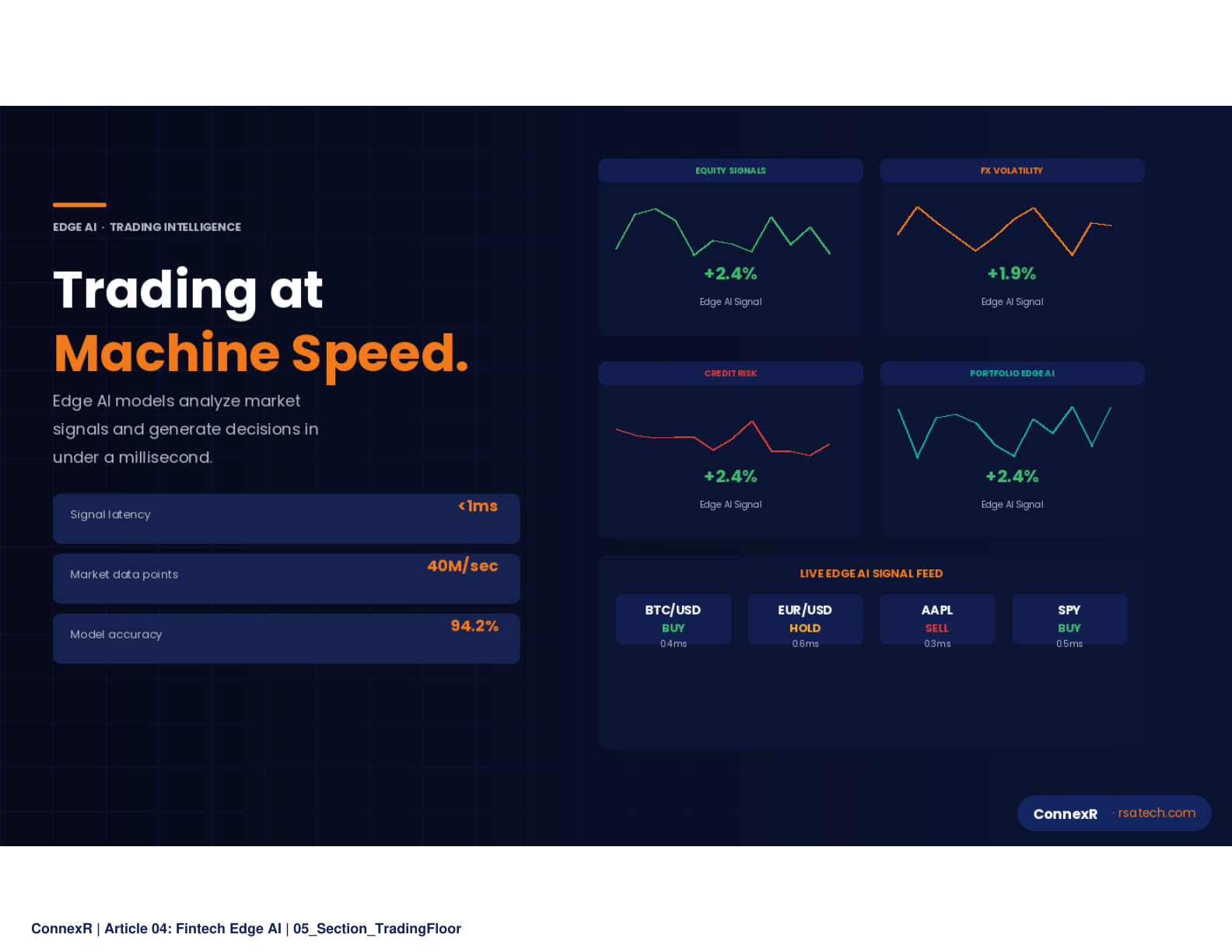
Edge computing has long been a critical capability in algorithmic trading, where co-located servers process market data and execute trades within microseconds. But the application of predictive analytics at the trading edge is evolving beyond simple speed optimization.
Modern edge-based trading systems deploy predictive models that analyze market microstructure, order book dynamics, news sentiment, and alternative data sources to make trading decisions in real time. These models must be updated continuously as market conditions change, requiring edge infrastructure that supports rapid model deployment, A/B testing, and rollback capabilities.
The integration of natural language processing (NLP) models at the trading edge is a particularly active area of development. Traders and algorithmic systems can now process earnings call transcripts, regulatory filings, and news feeds locally, extracting sentiment signals and entity relationships that inform trading decisions within seconds of publication.
Credit Decisioning and Risk Assessment
Traditional credit scoring relies on centralized models that evaluate a limited set of financial variables: credit history, income, outstanding debt. Edge-based predictive analytics enables a richer, more dynamic approach to credit risk assessment.
By processing alternative data sources at the edge -- transaction patterns, utility payments, mobile phone usage data, supply chain signals -- financial institutions can extend credit to underserved populations that lack traditional credit histories. This is particularly impactful in emerging markets where formal credit bureau coverage is limited but mobile banking adoption is high.
Edge-based credit decisioning also enables real-time risk adjustment. A merchant's line of credit can be dynamically recalibrated based on daily transaction volumes processed at the edge, rather than awaiting a periodic review by a centralized risk team.
"The future of fintech is not just faster. It is closer: closer to the customer, closer to the data, closer to the decision."
The Technology Stack for Edge Financial Analytics
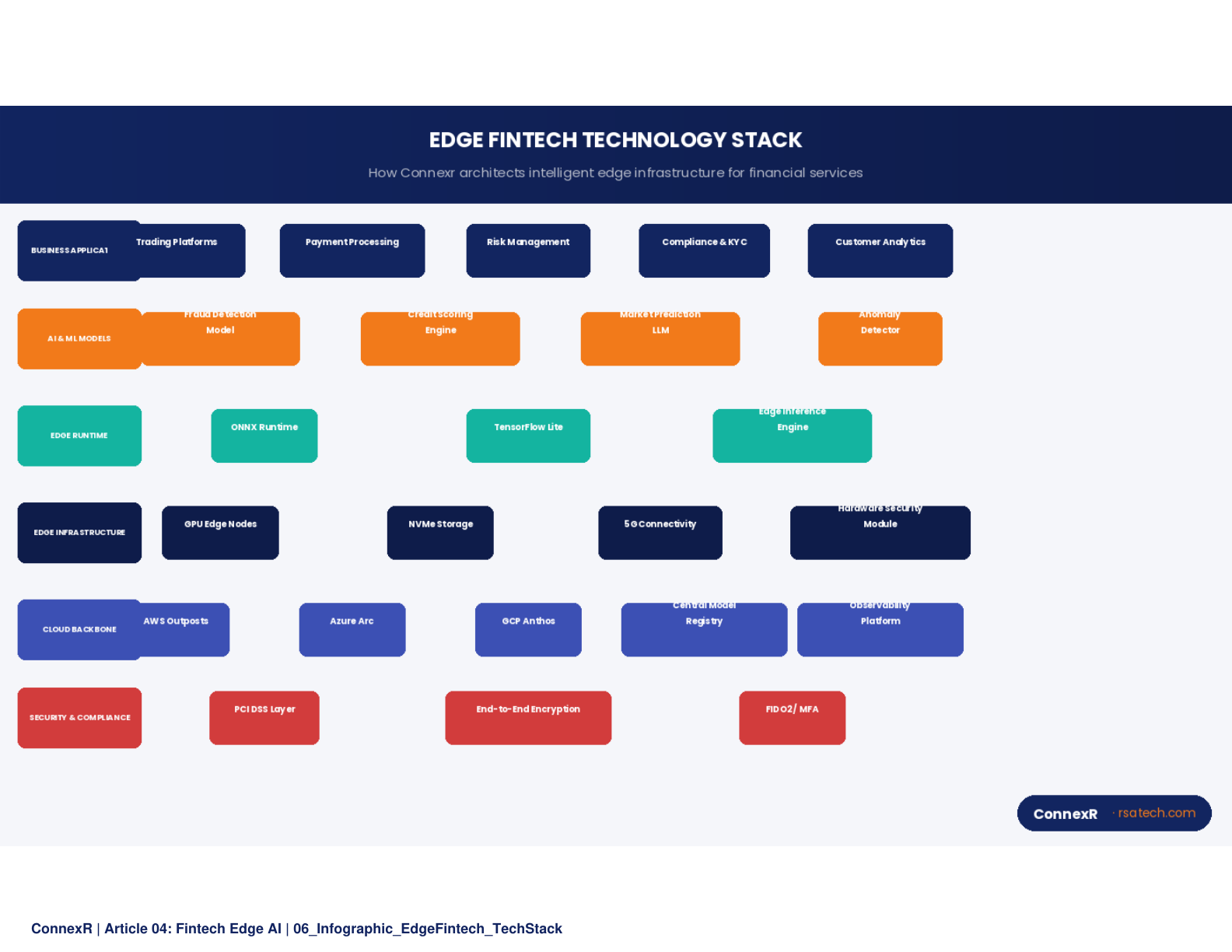
Building a production-grade edge analytics capability for financial services requires a technology stack that addresses computation, connectivity, security, and model lifecycle management.
Edge Hardware
Financial edge computing runs on a spectrum of hardware, from GPU-accelerated edge servers in data centers and co-location facilities to specialized inference chips embedded in payment terminals and mobile devices. The choice of hardware depends on the latency requirements, model complexity, and deployment environment of each use case.
Model Optimization and Deployment
Machine learning models designed for cloud inference often cannot run efficiently at the edge. Techniques like model quantization, pruning, knowledge distillation, and compilation for edge-specific hardware (using frameworks like TensorRT, ONNX Runtime, or TensorFlow Lite) are essential for deploying performant models on resource-constrained edge devices.
Edge-Cloud Orchestration
Edge computing does not replace the cloud. It extends it. A robust edge-cloud orchestration platform manages model deployment, monitoring, and updates across thousands of edge nodes. It aggregates telemetry and performance data from the edge for centralized analysis. And it implements fallback logic that routes requests to cloud infrastructure when edge resources are unavailable or when a request exceeds local processing capability.
Security at the Edge
Financial edge infrastructure is a high-value target. Security at the edge requires hardware-based secure enclaves for model and data protection, encrypted communication between edge nodes and centralized systems, Zero Trust access controls that verify every connection to edge infrastructure, and tamper detection and automated lockdown for physical edge devices.
Edge Analytics by the Numbers
80% -- Financial data generated outside data centers by 2027
< 10ms -- Edge fraud detection latency
200-500ms -- Cloud fraud detection latency
$118B -- False positive cost to financial industry (annual)
1.2B+ -- Mobile banking users in emerging markets
What Financial Services Leaders Should Do Now
The shift to edge-based predictive analytics is not a future possibility. It is happening now. Financial institutions that delay will find themselves at a competitive disadvantage in fraud prevention, customer experience, and operational efficiency.
First, identify the use cases where edge analytics delivers the highest value. This is typically fraud detection, real-time personalization, or latency-sensitive trading operations.
Second, assess the current infrastructure's readiness for edge deployment. This includes hardware capabilities, network architecture, and model operations maturity.
Third, build or partner for the specialized capabilities that edge AI demands. Model optimization, edge-cloud orchestration, and security hardening for distributed infrastructure are not commodity skills.
The financial institutions that master predictive analytics at the edge will define the next era of fintech: one where intelligence is not centralized and delayed, but distributed and instantaneous.
Ready to Bring Predictive Intelligence to the Edge? Connexr partners with financial services organizations to design and deploy AI-powered analytics at the edge and in the cloud. With deep expertise in fintech, predictive analytics, and enterprise security, we help institutions build intelligent systems that operate at the speed of modern finance.