
Key Takeaways
A digital twin is a living simulation: A data-driven simulation that mirrors physical operations and prescribes optimal actions in real time.
Predictive maintenance delivers massive ROI: Digital twins deliver 30-50% reduction in unplanned downtime and 10-25% reduction in total maintenance costs.
Three generations of evolution: Descriptive (monitoring), predictive (forecasting), and prescriptive (autonomous action) twins represent increasing capability.
Core technology stack: IoT sensors, physics-based models, machine learning, and edge-cloud hybrid computing form the foundation.
Foundation for autonomous factories: Digital twins are the foundational technology for the autonomous factory vision of Industry 4.0.
Manufacturing is entering an era where every asset, process, and production line has a living digital counterpart: a real-time virtual representation that mirrors physical operations, predicts future states, and enables decisions that were previously impossible without stopping the line. This is the promise of digital twins, and in 2026, it is no longer a futuristic concept. It is a production-grade capability that leading manufacturers are using to reduce unplanned downtime by up to 50%, improve product quality, and optimize operations with a precision that traditional approaches cannot match.
A digital twin is more than a 3D model or a dashboard. It is a dynamic, data-driven simulation that continuously ingests sensor data, operational metrics, and environmental conditions from a physical asset or process. It applies physics-based models and machine learning algorithms to that data to simulate current behavior, predict future states, and prescribe optimal actions. When properly implemented, a digital twin becomes the central nervous system of a manufacturing operation, connecting the physical and digital worlds in a continuous feedback loop.
The Evolution of Digital Twins in Manufacturing
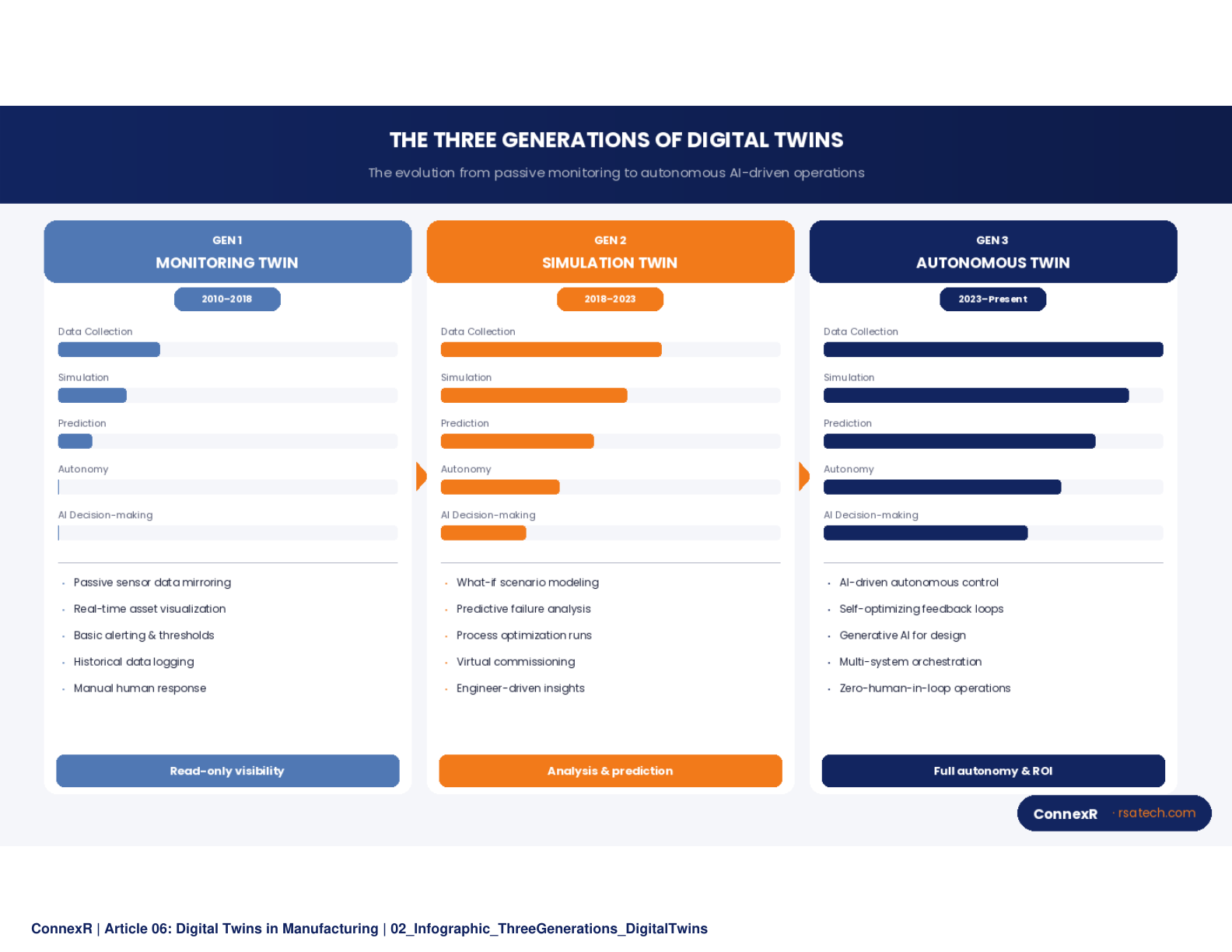
Digital twins have evolved through three distinct generations, each building on the capabilities of the last.
Generation 1: Descriptive Twins
The first generation focused on visualization and monitoring. These descriptive twins provided a real-time digital representation of physical assets: a 3D model of a turbine, a process flow diagram of a production line, or a spatial map of a warehouse. They ingested sensor data to display current state (temperature, pressure, vibration, throughput). They were useful for monitoring but did not predict or prescribe.
Generation 2: Predictive Twins
The second generation added predictive capability. By combining physics-based models with historical data and machine learning, predictive twins could forecast future asset behavior: when a bearing would fail, when a product batch would fall out of specification, when a production bottleneck would emerge. Predictive twins transformed maintenance from reactive and scheduled approaches to condition-based and predictive strategies, delivering significant reductions in unplanned downtime and maintenance costs.
Generation 3: Prescriptive and Autonomous Twins
The current generation, prescriptive twins, goes beyond prediction to recommendation and, increasingly, autonomous action. A prescriptive twin does not just predict that a motor will overheat in 72 hours. It evaluates the available response options (reduce load, schedule maintenance, reroute production) and recommends or automatically executes the optimal action based on business constraints like delivery schedules, inventory levels, and maintenance crew availability.
The trajectory points toward fully autonomous digital twins that operate manufacturing systems with minimal human intervention, making real-time adjustments to production parameters, scheduling maintenance, and optimizing energy consumption based on continuous analysis of the physical environment.
Core Components of a Manufacturing Digital Twin
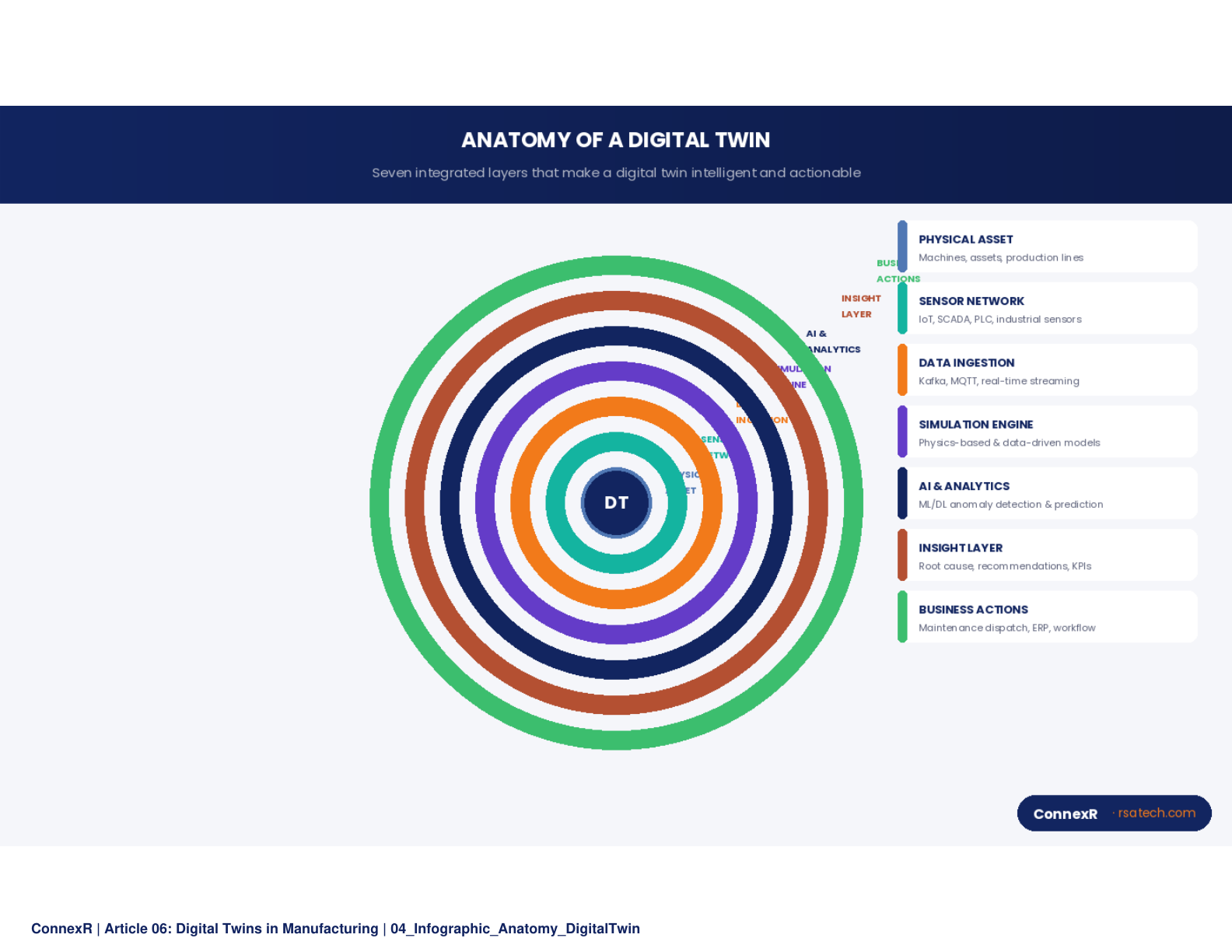
A production-grade digital twin requires several interconnected technology layers.
IoT and Sensor Infrastructure
The digital twin's accuracy depends entirely on the quality and breadth of its data inputs. A comprehensive IoT layer includes vibration, temperature, pressure, and humidity sensors on critical equipment, machine vision systems for quality inspection, energy meters and environmental monitors, and production execution system (MES) integration for process data.
The sensor infrastructure must deliver data at the frequency and latency required by the twin's models. A predictive maintenance twin for a high-speed packaging line may require vibration data at 10,000 samples per second. A process optimization twin for a chemical batch may only need temperature readings every 30 seconds. The IoT architecture must accommodate both.
Data Integration and Contextualization
Raw sensor data is not useful until it is contextualized. A temperature reading of 185 degrees means nothing without knowing which asset it came from, what the asset's normal operating range is, what product it is currently producing, and what the ambient conditions are. The data integration layer maps sensor data to asset models, enriches it with contextual information from enterprise systems (ERP, MES, CMMS), and maintains the temporal relationships that time-series analysis requires.
Physics-Based and Machine Learning Models
The analytical core of a digital twin combines two types of models.
Physics-based models encode the fundamental engineering principles that govern asset behavior: thermodynamics, fluid mechanics, structural mechanics, electrical theory. These models provide a robust baseline understanding of how equipment should behave under known conditions.
Machine learning models complement physics-based models by capturing complex, nonlinear relationships that first-principles models cannot fully describe. An ML model trained on historical failure data can identify subtle patterns in vibration spectra that precede bearing failure, patterns too complex for a physics model to capture analytically.
The most effective digital twins use hybrid approaches that combine both model types, using physics-based models for extrapolation to conditions the ML model has not seen and ML models for the nuanced pattern recognition that physics models cannot provide.
Visualization and Interaction Layer
The user interface of a digital twin must serve multiple audiences: operators monitoring real-time conditions, maintenance technicians diagnosing equipment issues, engineers optimizing process parameters, and executives reviewing operational performance.
Effective visualization combines:
- 3D spatial representation of assets and facilities
- Real-time dashboards for KPIs and alerts
- Interactive simulation capabilities for what-if analysis
- Augmented reality overlays that project digital twin data onto physical equipment for field technicians
"A digital twin is not a monitoring tool. It is an operational brain: sensing, thinking, and acting in real time."
High-Impact Use Cases in Manufacturing
Predictive Maintenance and Asset Optimization
Predictive maintenance remains the most widely deployed and highest-ROI application of digital twins in manufacturing. By continuously monitoring asset condition and predicting failure probabilities, digital twins enable manufacturers to:
- Extend equipment life by optimizing operating conditions
- Schedule maintenance during planned downtime to minimize production impact
- Reduce spare parts inventory by ordering based on predicted need rather than safety stock
- Prioritize maintenance activities based on business criticality rather than fixed schedules
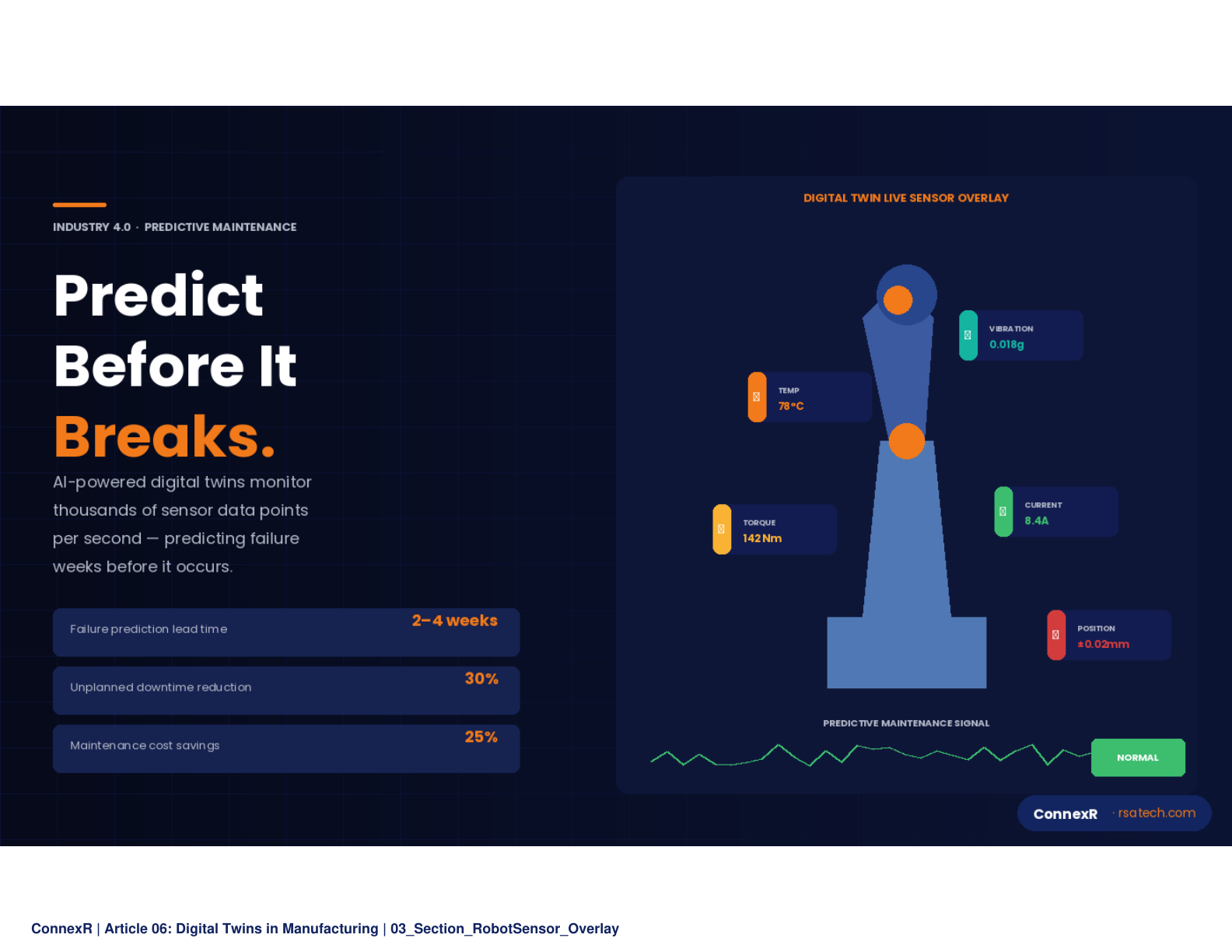
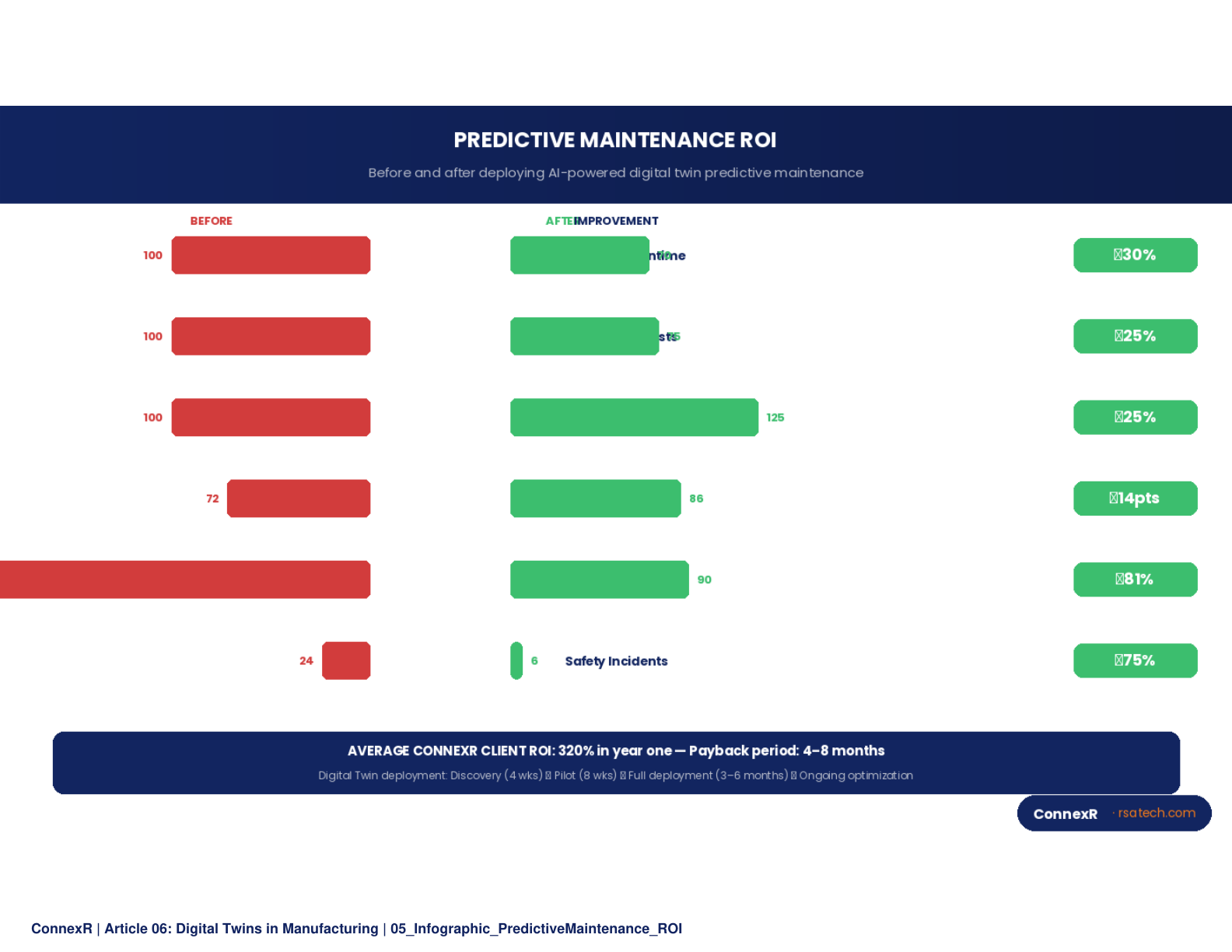
Manufacturers implementing digital twin-based predictive maintenance consistently report 30 to 50% reductions in unplanned downtime and 10 to 25% reductions in total maintenance costs.
Production Process Optimization
Digital twins of production processes (not just individual assets, but entire lines and workflows) enable real-time optimization of throughput, quality, and resource utilization.
A process digital twin can:
- Simulate the impact of parameter changes before they are applied to the physical process
- Identify root causes of quality excursions by correlating process variables across the entire production chain
- Optimize production scheduling by simulating different sequencing scenarios
- Balance energy consumption against throughput to minimize unit production costs
Product Digital Twins
Product digital twins track an individual product through its entire lifecycle, from design and manufacturing through operation and end-of-life. In manufacturing, product twins enable traceability that connects field failures back to specific production conditions, batches, and components. This closes the feedback loop between manufacturing and design, enabling continuous product improvement based on real-world performance data.
Supply Chain and Factory-Level Twins
The most ambitious digital twin implementations extend beyond individual assets to model entire factories and supply chains. A factory digital twin integrates asset twins, process twins, and logistics models into a comprehensive simulation of the entire manufacturing operation. This enables scenario planning for capacity expansion, demand fluctuations, or supply disruptions. It supports energy management optimization across the entire facility. And it provides the foundation for autonomous factory operations, where the digital twin manages production scheduling, resource allocation, and maintenance coordination with minimal human intervention.
Digital Twin Impact Metrics
30-50% reduction in unplanned downtime
10-25% reduction in total maintenance costs
Up to 20% improvement in overall equipment effectiveness (OEE)
10-15% energy cost reduction through twin-optimized operations
$110B+ projected global digital twin market by 2028 (MarketsandMarkets)
Implementation Challenges and How to Overcome Them
Data Quality and Sensor Coverage
Digital twins are only as accurate as their data inputs. Many manufacturing environments have incomplete sensor coverage, inconsistent data formats, and legacy equipment that was not designed for digital connectivity. A pragmatic approach is to start with critical assets where sensor data is available and the business impact of predictive capability is highest, then expand coverage incrementally as ROI is demonstrated.
Integration with Legacy Systems
Manufacturing environments typically run a complex stack of legacy systems (SCADA, MES, ERP, CMMS) that were not designed to feed data to digital twins in real time. Integration requires middleware that can extract data from these systems without disrupting their operation and normalize it into the formats and frequencies that digital twin models require.
Organizational Change Management
Digital twins change how maintenance, operations, and engineering teams work. Maintenance teams must learn to trust predictive recommendations. Operators must incorporate simulation results into their decision-making. Engineers must adopt model-driven design processes. Success requires investment in training, clear demonstration of value, and a gradual transition that builds confidence in the digital twin's capabilities.
Scalability
The computational demands of digital twins scale with the number of assets, the complexity of models, and the frequency of data ingestion. An architecture that works for 10 assets may not work for 10,000. Cloud-edge hybrid architectures (where time-sensitive inference runs at the edge and complex simulation runs in the cloud) provide the scalability that enterprise-wide digital twin deployments require.
Start Small, Scale Fast
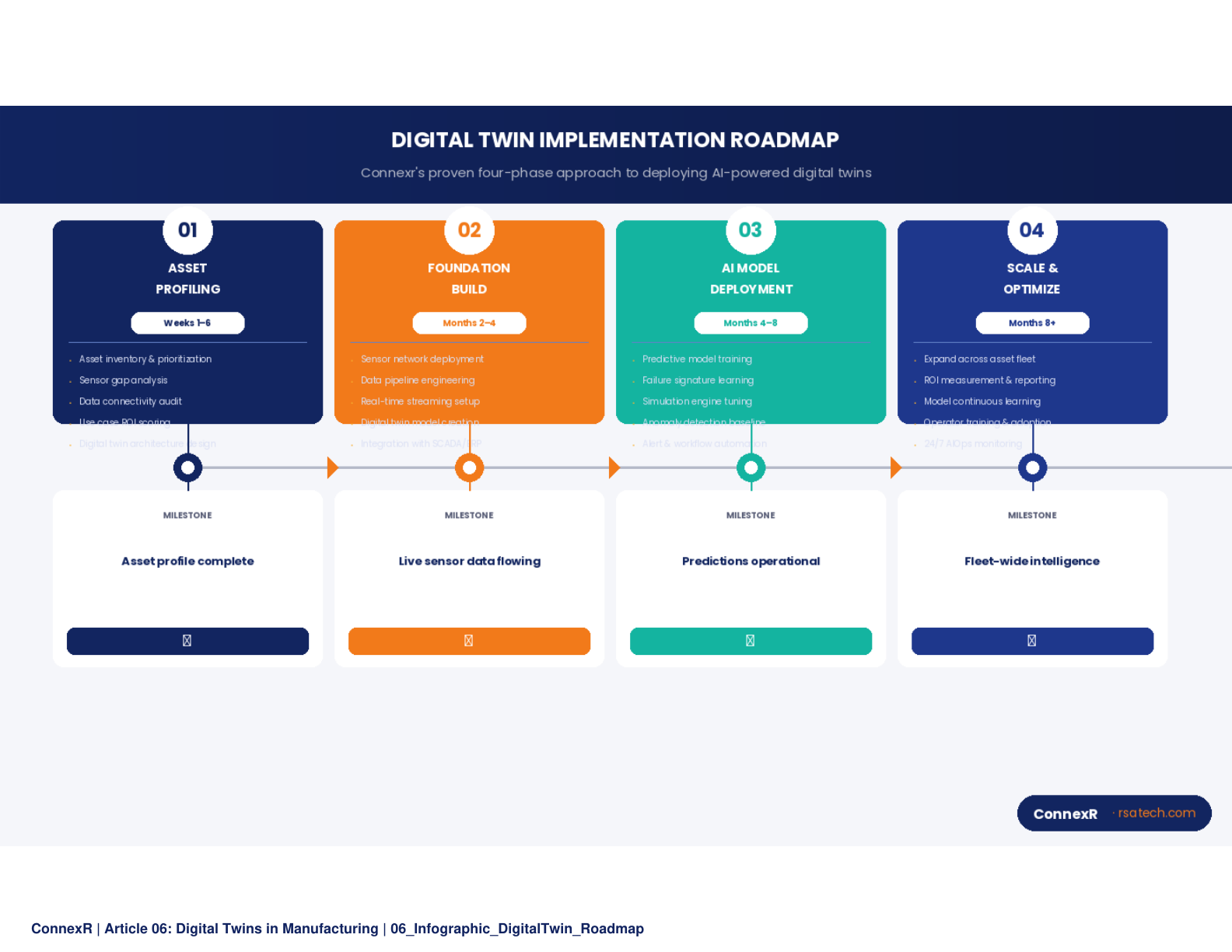
The most successful digital twin implementations begin with a single high-impact use case on critical assets, demonstrate ROI within 6-12 months, then expand incrementally. Each month of operational data improves model accuracy, and each deployment builds organizational capability.
The Future: Autonomous Manufacturing
Digital twins are the foundational technology for the autonomous factory: a manufacturing operation that self-monitors, self-optimizes, and self-heals with minimal human intervention. As AI models become more capable, sensor coverage becomes more comprehensive, and edge computing provides the real-time processing that autonomous control demands, the digital twin evolves from a decision-support tool to an autonomous operator.
This is not a distant vision. Leading manufacturers in aerospace, automotive, pharmaceuticals, and semiconductor fabrication are already operating digital twin-driven autonomous systems for specific process steps. The next decade will see these capabilities extend to entire production lines and, eventually, entire facilities.
For manufacturers that begin building their digital twin capabilities now, the competitive advantage compounds over time. Each month of operational data improves model accuracy. Each use case deployment builds organizational capability. Each iteration of the digital twin moves the organization closer to the autonomous manufacturing future that defines Industry 4.0.
Ready to Build Your Manufacturing Digital Twin? ConnexR partners with manufacturers to design, build, and operate digital twin platforms that transform operations through predictive intelligence and autonomous optimization. Our expertise in IoT, AI, and enterprise systems integration enables manufacturers to move from pilot to production-scale digital twin deployments.